
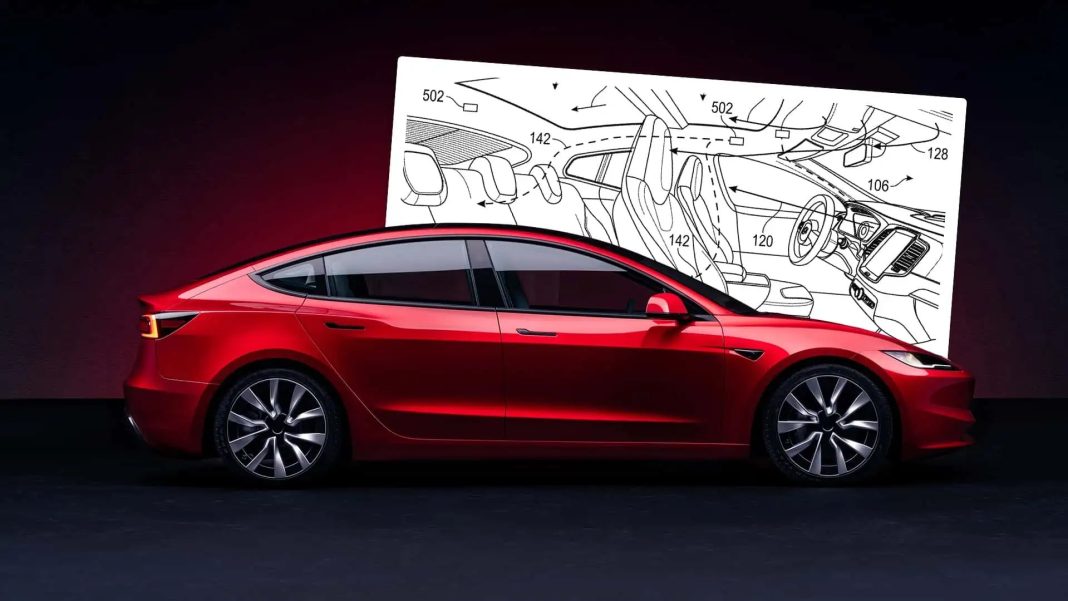

Summer is the silent enemy of any electric vehicle. While the cold is already known for draining range, heat does exactly the same from the opposite side: turning on the air conditioning on a hot day can consume up to 18% of the battery's capacity, transforming a peaceful trip into an anxious race against battery depletion. Tesla knows this better than anyone, and Elon Musk's company has just registered a patent with a solution that is as unexpected as it is ingenious: sucking in the hot air from inside the car.
The central idea of the patent is deceptively simple. The proposed system involves installing a suction unit integrated into the vehicle's HVAC system, capable of creating negative pressure, or vacuum, directed towards specific vents inside the cabin. These vents are positioned near so-called hot air pockets, areas where heat accumulates more intensely and that typically require more effort from the climate control system to be managed. The hot air is then sucked directly into the HVAC system, conditioned together with the rest of the cabin air, and recirculated back into the vehicle.
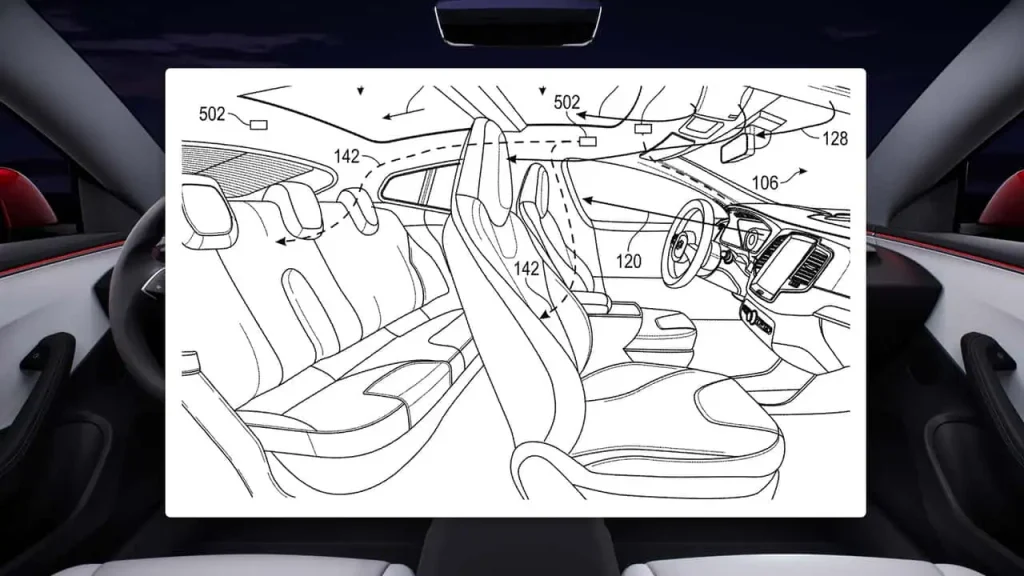
A practical example helps to understand the logic behind this innovation. The panoramic glass roof, present in several models of the brand, is an extremely effective solar heat collector. Anyone who has entered a car parked in the sun knows what this means. In larger models, such as the Model X, the surface area of glass exposed to the sun is considerably larger than in a Model 3, which proportionally increases the volume of warm air that the climate control system has to manage. Tesla's solution does not eliminate this physical reality, but addresses it more intelligently than simply turning the air conditioning to maximum and hoping the problem goes away.
The numbers presented in the patent itself are concrete and revealing. The technology can reduce the energy consumption of the climate control system by up to 7.4%, which at an outside temperature of 40 degrees Celsius represents a saving of about 127 watts. In practical terms, the peak consumption of the HVAC system would decrease from 1,720 watts to 1,593 watts. The patent also specifies that the suction can be activated conditionally, with temperature sensors continuously monitoring the interior of the cabin and activating the system only in areas that actually need to be climate controlled, avoiding energy waste.
The stated objective, according to the patent document, is to maximize thermal comfort and minimize energy consumption. In more straightforward terms: to make passengers feel good while using as little battery as possible to achieve that. In a sector where every extra kilometer of range represents a significant commercial advantage and where charging anxiety remains one of the main concerns for potential electric vehicle buyers, a 7.4% improvement in air conditioning efficiency is not a small number. It is the difference between arriving at the destination with a comfortable margin or not.
It is important to contextualize what this news represents and what it does not represent. A patent is not a product. Tesla regularly registers inventions that never make it to production, and this vacuum technology may very well remain on paper or take years to reach a real car. But the fact that the company invests time and intellectual resources in this type of innovation reveals something important about the brand's strategic direction: improving range without touching the battery, aerodynamics, or propulsion system. It is efficiency engineering applied to a problem that affects all electric vehicle drivers without exception, especially in the summer months, particularly in hot climate countries.
Portugal, with its Mediterranean summers and temperatures that regularly rise above 35 degrees in much of the territory, is precisely the type of market where such a technology would make all the difference in the daily lives of those traveling in an electric vehicle. If Tesla can turn this patent into reality within the next few years, owners of Model 3, Model Y, and Model X will finally be able to turn on the air conditioning without feeling that they are sacrificing kilometers of range for every kilometer they travel.