
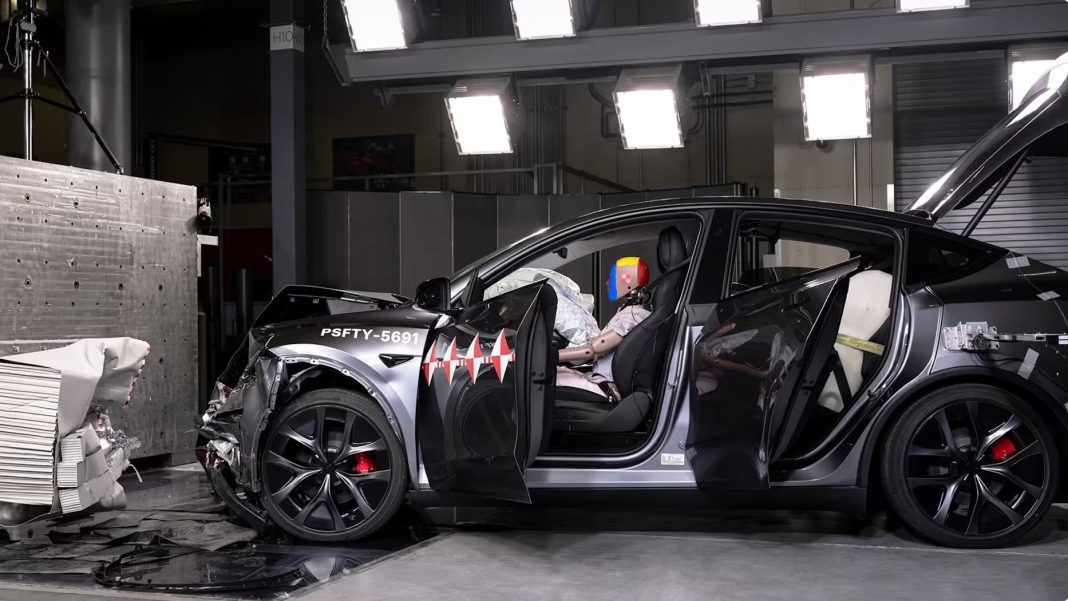

Seventy milliseconds. That is the time that separates an airbag activated at the right moment from an airbag activated too late. In a highway speed accident, this difference translates to between one and one and a half meters of distance traveled by the occupant before the protection is fully active. It is the difference between a serious injury and getting out of the car on one's own. And it is precisely this interval that Tesla has just achieved with an update to its Tesla Vision system, which is now capable of activating airbags and pre-tensioning seat belts before any physical impact occurs.
Elon Musk announced the news on his account on the X network with a direct and straightforward statement: “Tesla AI Vision deploys airbags before impact, which greatly reduces risk of injury or death. This comes for free on all new cars.” The statement summarizes the extent of the innovation: a passive safety system that ceases to be reactive and becomes predictive, using cameras and artificial intelligence to anticipate the inevitable and prepare the cabin before the occupant's body begins to move forward.
The operation of the system is as elegant in its logic as it is challenging in its technical execution. The new capability added to Tesla Vision allows the system to observe and identify when the car is about to make contact with another object, as well as the potential severity of the collision, passing this information to the airbag controller so that they can begin to activate and the seat belts can be pre-tensioned. The entire process takes only 70 milliseconds. Traditional airbag activation systems rely on accelerometers installed in the bumpers and chassis that must register the physical impact before ordering activation. By definition, they always arrive late relative to the ideal moment.
What makes this possible is the scale of Tesla's fleet. Traditional automakers develop their safety systems based on a few dozen regulatory crash tests conducted in a laboratory. Tesla, on the other hand, analyzes data from millions of real-world kilometers. Wes Morrill, chief engineer of the Cybertruck at Tesla, explained that the company uses a model of the human body in simulations to recreate real accidents from the fleet, describing a graph that showed a significant reduction in the severity of injuries thanks to the system: “Each of these points is a real accident from the fleet. Real speeds, real collisions, and real people. Not just the regulatory test cases.”
The availability of this functionality is broader than one might expect from a technology of this nature. Vision-based activation was initially made available with software version 2025.32.3 last September and is currently available in the 2023 or newer Model 3 and Model Y, as well as in some 2022 models, and in the latest versions of the Model S and Model X, including the 2026 models. The delivery was made via over-the-air update, meaning that owners received this additional safety capability without the need to visit any service center, at no additional cost, and without any physical intervention in the vehicle.
The context in which this announcement is made is not neutral. The announcement comes at a time when Tesla is facing federal scrutiny over its camera-only approach, after the NHTSA opened an investigation covering about 2.4 million Tesla vehicles following accidents involving Full Self-Driving in reduced visibility conditions. The public demonstration of this capability, accompanied by a 73-second video featuring crash tests with dummies, Tesla engineers, and slow-motion comparisons, is both a genuine innovation and a strategic response to regulatory criticisms.
70 milliseconds may seem trivial, but in collision physics, they are substantial. A fully inflated airbag can meet the occupant at the ideal point of their forward motion trajectory, reducing the risk of injuries caused by the airbag itself, including cervical trauma that can occur when the airbag is deployed a fraction of a second too late.
Automotive safety has been anchored for decades in physical sensors that react to what has already happened. Tesla is proposing a paradigm shift to systems that anticipate what is about to happen. If the industry adopts this philosophy on a large scale, future car accidents could be significantly less lethal, not because cars will avoid more collisions, but because their protection systems will be ready before they occur.