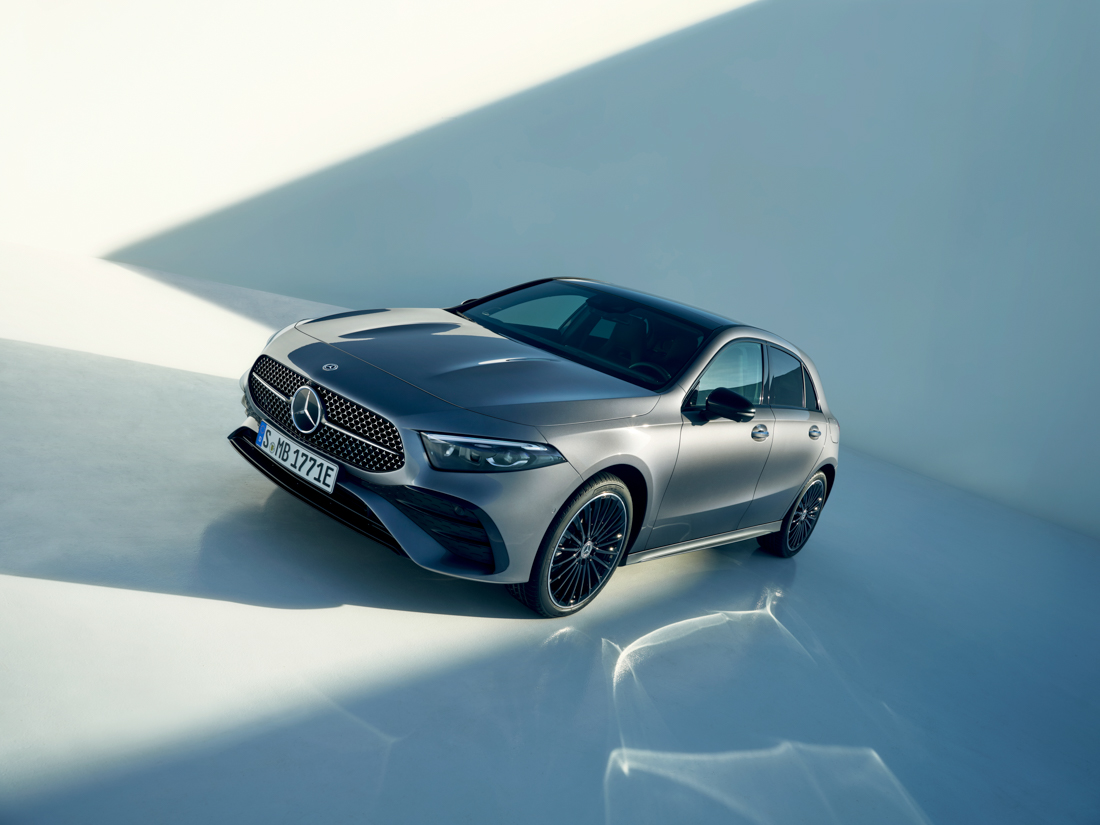
Less than a year after the announcement by Mercedes-Benz that the current A-Class would be discontinued, a representative of the star brand, in statements to the newspaper Automobilwoche, has now revealed that its commercial career will continue until 2028 (when the current generation will reach a decade of existence…), although its production will take place, starting from the second half of this year, at the German manufacturer’s factory located in Kecskemét, Hungary. According to the same source, the goal is to free up production capacity at the Rastatt factory in Germany (from which the entry-level model of the Stuttgart brand has been produced), both for the new CLA and CLA Shooting Brake, as well as for the new generation of the GLA, which will also be manufactured there starting in 2027 – and will offer both 100% electric and thermal versions, in order to also replace the current EQA, and to fulfill Mercedes’ new directive to include both types of engines in the majority of its offerings.
If this decision prevents one of the oldest models currently using the three-pointed star from continuing to bear the status of “Made in Germany,” on the other hand, it should allow for a reduction in manufacturing costs, assuming that both operational and labor costs will be lower in Hungary than in Germany. No less interesting is the (strong) possibility that the A-Class may see a successor (which will not happen with the B-Class, which will be gradually discontinued), contrary to what was initially established by the strategy defined in 2022 by Ola Källenius, CEO and Chairman of the Board of Mercedes since 2019: to focus on “ultra-luxury” to ensure the commercial and financial results desired by shareholders, something that they themselves began to contest when it did not happen, and which may have led to a sharp correction of the course then charted.
It is known that the future generation of the A-Class, positioned below the CLA, will be available exclusively in the five-door hatchback format, still very popular in Europe, or if Mercedes will take the opportunity to revive the three-volume, four-door variant, a body configuration highly sought after in other regions. What seems certain is that the Stuttgart manufacturer is not willing to give up a younger, less affluent clientele that it has worked hard to attract, although it is a fact that high volumes will tend to compensate for less substantial profit margins than those guaranteed by its larger and more premium offerings, there will be those who counter-argue that this will not help position Mercedes as a truly luxury brand. But if there is a brand that, over more than a century, has shown to be less vulnerable to the supposed drawbacks of offering vehicles for (almost) all types of customers, and intended for (almost) all types of uses, without losing its “premium” status, it is this one…