
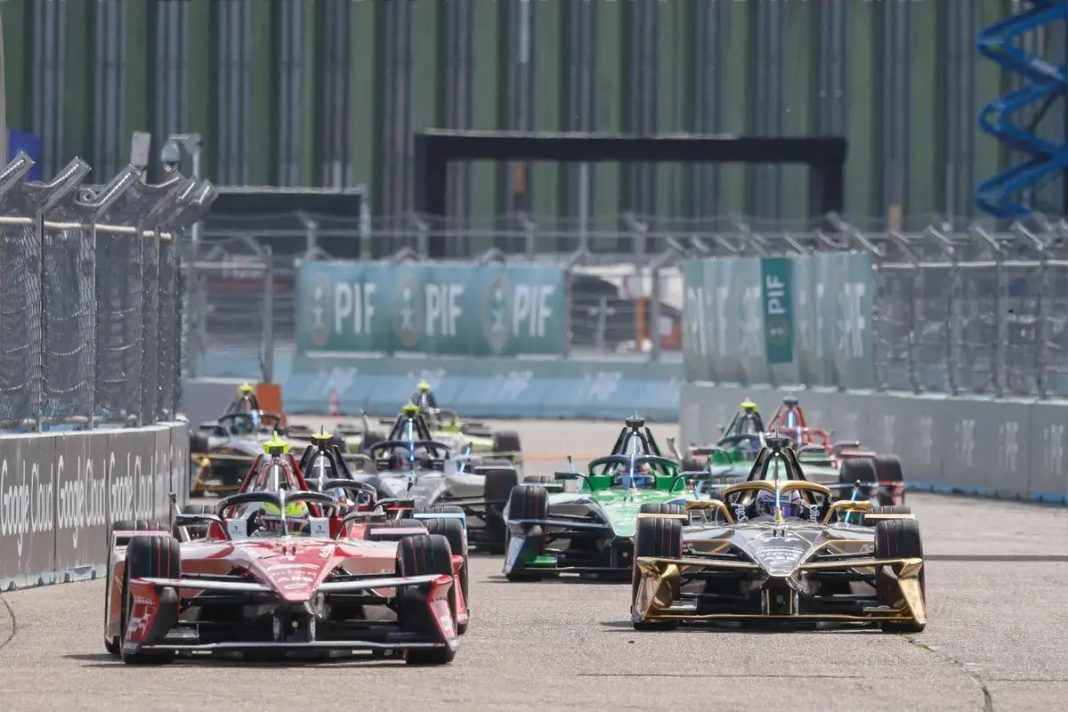

Title: Controversy Erupts: Did Oliver Rowland Break the Rules with a Risky Overtake During Berlin E-Prix?
In a thrilling turn of events at the Berlin E-Prix, Oliver Rowland’s audacious overtake of Pascal Wehrlein has ignited a firestorm of debate among fans and analysts alike. The pivotal moment, which took place on lap 34, saw Rowland snatch second place with a controversial maneuver that seemingly unfolded under a yellow flag. But was it a breach of protocol, or a perfectly legal move?
The drama began as a substantial piece of debris littered the start-and-finish straight, prompting race officials to deploy a yellow flag. However, Rowland capitalized on his 350kW attack mode advantage to surge past Wehrlein, leading commentators James Rossiter and Sam Bird to initially express their expectation of an impending investigation into the potential rule violation. Surprisingly, no inquiry ever materialized, leaving many scratching their heads.
The crux of the confusion lies in the interpretation of the flags waved during the incident. Evidence from Rowland's onboard camera reveals a 'yellow' status on his digital display as he initiated the overtake, which then shifted to a 'yellow-and-red' flag as he completed the daring pass. This nuanced distinction is critical—while overtaking is prohibited under a standard yellow flag, it is allowed during a slippery surface warning, which is indicated by the yellow-and-red striped flag.
According to the official FIA timing data, the sequence of flags was as follows: a yellow flag was displayed, followed by a slippery surface indication, and then reverted back to yellow. The slippery surface flag is designed to alert drivers to reduced grip conditions due to factors like oil or water on the track, and is not as restrictive as a standard yellow flag.
Rowland himself was blissfully unaware of any controversy brewing post-race. He stated, “I saw in my dash that it was the 'YR', the yellow-and-red, so I didn't even consider [the potential issue] until told afterward. And then I was like, I didn't see a yellow flag.” His perspective adds an intriguing layer to the narrative, underscoring the complexity of the situation.
The fallout from this incident has left the Porsche team visibly disgruntled. While they felt that Rowland should have faced repercussions for his actions, they were left powerless to lodge a protest due to the lack of an official investigation into the incident. The disappointment within Porsche is palpable, as they hoped for a thorough review of the situation.
Wehrlein, who has since reclaimed his position as championship leader, also expressed surprise at the aftermath of the overtake. He revealed, “I didn't even see a flag,” and adopted a laid-back attitude, stating, “On things I cannot control, I just take it as they come, I don't mind.” This remark reflects a sense of resignation amidst the uproar, as he now leads Rowland by three points with an 18-point cushion.
As the dust settles on this electrifying race, the implications of Rowland's daring move linger in the air. Was it a bold display of skill, or a reckless gamble that should have cost him dearly? The debate rages on, and the motorsport community watches closely as the ramifications of this decision unfold. One thing is for certain: the Berlin E-Prix will be remembered for more than just its high-speed action—it has reignited the conversation about the integrity and enforcement of racing regulations.