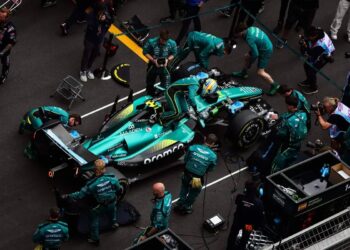
F1 2026: The Crucial Role of Car Batteries in a New Era of Racing
As the countdown to the thrilling 2026 Formula 1 season begins, the spotlight is not solely on the groundbreaking chassis and power unit regulations but also on an unsung hero—the car battery. Yes, you heard it right! The battery is set to play a pivotal role in this year's races, and its significance cannot be overstated. In a sport where every millisecond counts, mastering battery management could be the key to victory.
Max Verstappen, reigning world champion, has already drawn a bold comparison, labeling the new F1 cars as “Formula E on steroids.” This electrifying statement underscores the dramatic shift towards electric power in F1, making understanding the battery’s function more critical than ever. But how exactly does this high-performance energy storage work?
Forget the heavy lead-acid batteries of your everyday vehicle; F1 cars utilize advanced lithium-ion technology. This state-of-the-art battery system is not just another component; it's a sophisticated powerhouse capable of delivering rapid bursts of energy essential for race performance. Unlike conventional road car batteries, F1 batteries focus on extreme power density rather than sheer capacity. This means they can unleash ferocious amounts of energy on demand, a necessity for the high-octane environment of Formula 1.
At the heart of this engineering marvel lies a complex design featuring an anode (the negative electrode), a cathode (the positive electrode), and an electrolyte, which, while typically liquid, may soon transition to solid-state technology. The charging process, historically reliant on the Motor Generator Unit – Kinetic (MGU-K) and the now-defunct Motor Generator Unit – Heat (MGU-H), has undergone a significant overhaul for 2026. The MGU-H has been scrapped, putting the onus on drivers to master kinetic energy recovery methods.
Why should this matter to you? In 2026, the power dynamics are shifting dramatically. The maximum electrical output will skyrocket from 120kW to a staggering 350kW, creating an almost equal split between battery power and the internal combustion engine. Drivers must harness up to nine Megajoules (MJ) of energy per lap to optimize their performance, and the new energy recovery system allows for battery recharging at double the speed of previous seasons. This is not just an upgrade; it’s a game-changer.
During races, drivers will rely heavily on their battery reserves to activate crucial features such as the boost button and the innovative overtake mode, which grants an extra 0.5 MJ of energy when closely trailing another car. This capability acts as a strategic advantage, akin to the DRS system, but with the flexibility to deploy energy at any point during the lap. The implications are clear: effective battery management will be the difference between triumph and defeat.
So, how can drivers recharge their batteries on the fly? The answer lies in a series of tactics that require finesse and skill. They can engage in “lifting and coasting,” a technique that slows the car down without losing too much speed, thereby allowing for a full battery recharge before making a crucial move. Other traditional methods include braking, operating at half throttle, and a technique known as “super clipping,” which occurs at the end of a straight when the car is at full throttle.
The decision to eliminate the MGU-H was not made lightly; it was a costly piece of technology that offered minimal power gains. By focusing on these kinetic recharging methods, F1 is pushing drivers to hone their skills in battery management, a strategic necessity that will define the 2026 racing landscape.
The excitement is palpable as all 11 teams gear up for the season opener at the Australian Grand Prix in Melbourne on March 8, 2026. With the stakes higher than ever, the integration of advanced battery technology will undoubtedly shape the future of racing. Buckle up, because the 2026 Formula 1 season promises to be unlike anything we've ever seen!