The goal of total electrification of the European market by 2035, regarding the sale of new cars, seems to be increasingly a mirage. This is also because the number of manufacturers who do not seem willing to bear the setbacks that this measure is already having on their activity continues to rise.
Among them is undoubtedly Porsche, which has just appointed a new CEO: Michael Leiters in place of Oliver Blume, largely due to the disastrous financial results recently recorded by the German sports car brand. And, all indications suggest, it is not only developing a new SUV powered by thermal and hybrid engines, positioned below the Cayenne, and set to launch in 2028 (presumably based on the PPC platform, debuted by the latest generation of the Audi A5, but not called Macan, which should continue to be offered only in fully electric format), but also preparing to do the same with the future generation of the 718 Boxster and 718 Cayman, expected in 2026, originally designed to use exclusively 100% electric powertrains (the current models are only offered in the 718 Spyder RS and 718 Cayman GT4 RS versions, with 500 hp, and prices above 210,000 euros, and are expected to remain, after being duly updated, at the top of the range, above the electric models, until the arrival of the new ones powered by gasoline engines).
The possibility is suggested by various sources, notably by Autocar. Based on information gathered from members of the brand’s engineering department, the British publication reports that, under the “strategic realignment” of its offering (which will cost around 7.5 billion euros…), the Stuttgart manufacturer is already working on adapting the PPE Sport platform (Premium Platform Electric Sport) so that it can also accommodate combustion engines mounted in a rear central position.
All of this aims to ensure maximum production efficiency and the greatest benefits in terms of scale volumes of various key components, representing the most radical shift in direction ever for the Weissach company on this matter.
However, a decision of this magnitude brings significant challenges, with prolonged resolution times, especially for a brand with the pedigree of Porsche, meaning that these new gasoline 718 Boxster and 718 Cayman models are unlikely to hit the market before the end of the decade. Moreover, Porsche is determined that their dynamic performance will be at least on par with that of the electric versions, a not insignificant ambition, considering that the latter will benefit from a center of gravity considered “ultra-low.”
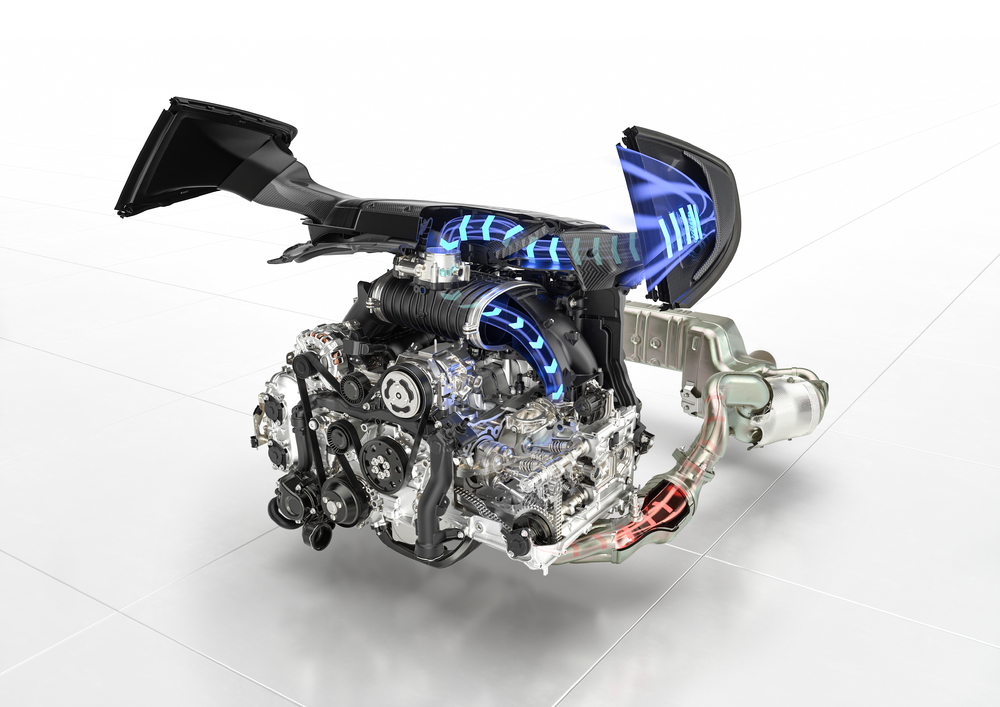
On the other hand, removing the high-voltage battery from a structure that was designed to rely on it as a fundamental component will result in a significant loss of stiffness that engineers will have to address, most likely by creating a new structural lower section that serves as the vehicle’s floor, can be applied at the same battery mounting points, and ensures the necessary robustness. While the rear section will have to be completely redesigned and receive a new subframe in order to accommodate the engine (which appears to be a more evolved derivative, and, of course, not as powerful, of the naturally aspirated six-cylinder horizontally opposed Boxer engine, with a capacity of 4.0 liters, currently used in the 718 Spyder RS and 718 Cayman GT4 RS, and debuted in the 718 family in 2020), the transmission and its central tunnel, the fuel tank, the gasoline supply circuit, and the exhaust line – all components absent in a fully electric vehicle.