
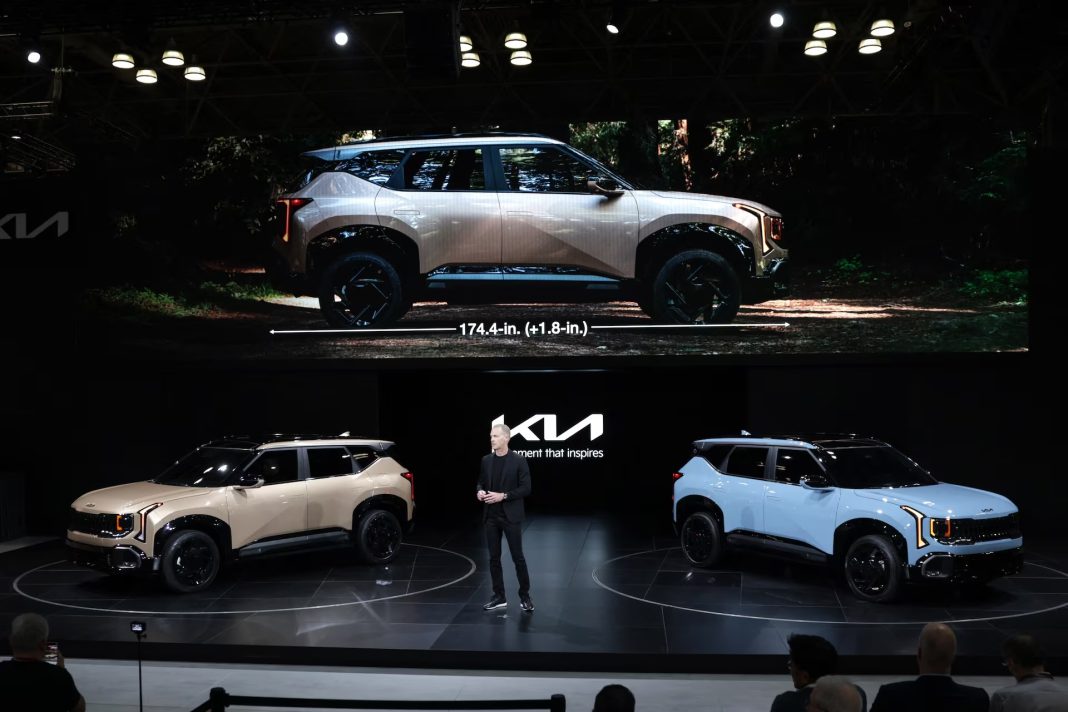

Despite the slowdown in demand, major automakers have once again invested in new electric models at the recent New York International Auto Show, signaling that electrification remains at the center of long-term strategies.
New models arrive even with declining demand
Among the new offerings, Kia confirmed the launch of the EV3 in the United States later this year, while Subaru unveiled the new seven-seat electric SUV Getaway, which is expected to hit the market between 2026 and 2027.
This investment comes in a challenging context, with the North American market facing a significant downturn following the end of the federal tax incentive of $7,500 for electric vehicles.
Sharp decline after the end of incentives
Recent data indicates that electric vehicles accounted for 9.6% of sales in 2025, but fell to 6.5% in the last three months, the lowest figure since early 2022.
Industry executives acknowledge that demand has clearly slowed. The absence of incentives and reliance on promotional campaigns have hindered the natural growth of the segment.
Fuel prices once again influence demand
Despite the adverse scenario, the recent rise in fuel prices is generating some renewed interest in electric vehicles.
Brands like Hyundai indicate that this trend is driven more by market conditions than by regulation, leading to a revision of strategies, with a greater focus also on hybrid models.
Slower growth than expected
Forecasts point to a gradual evolution of the electric market in the U.S., with vehicles of this type representing between 10% and 15% of the market in the coming years, far from the more ambitious projections previously considered.
Adjusted strategies among manufacturers
Manufacturers like Toyota continue to diversify their offerings, with new electric models expected this year, while General Motors strengthens its presence with more affordable models, such as the new Chevrolet Bolt.
A market in transition
Currently, electric vehicles represent only about 2.5% of the total vehicles in circulation in the United States, highlighting that the energy transition still faces structural challenges.
Future depends on economic and political factors
The evolution of the market will depend not only on technological supply but also on factors such as government policies, incentives, and energy prices.
Despite the difficulties, the continuous launch of new models demonstrates that manufacturers remain committed to electrification, albeit with a more cautious and gradual approach.