

Tragedy Strikes at Nurburgring: The Shocking Death of Juha Miettinen in a Devastating Crash
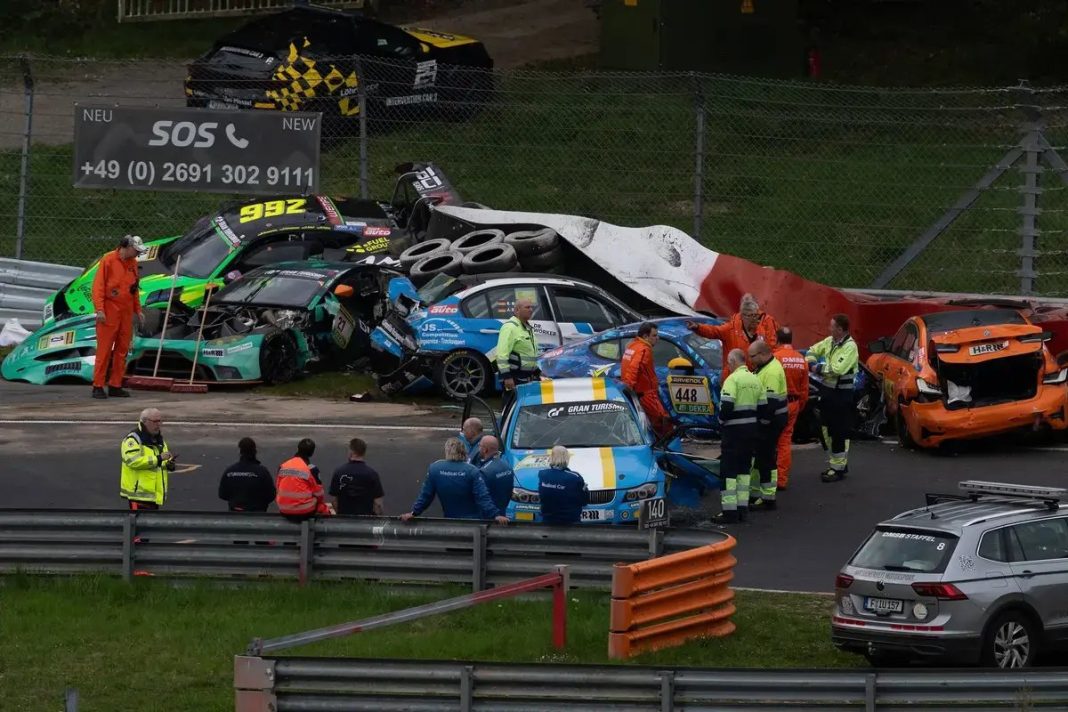
In a heart-wrenching turn of events last weekend, the motorsport community was rocked by the tragic death of Finnish driver Juha Miettinen during the 24h Qualifiers at the iconic Nurburgring. Reliable reports now reveal that Miettinen's fatal accident was triggered by a catastrophic multi-car pile-up, ignited by an unforeseen oil spill on the perilous approach to the Klosterthal curve, near the infamous Steilstrecke section.
The horror unfolded when the #503 BMW 330i collided head-on with the tire barrier, marking the beginning of a chain reaction that would lead to Miettinen’s demise. Following closely behind in his BMW 325i, Miettinen lost control due to the slick conditions and spun sideways. In a horrifying twist of fate, his vehicle struck the rear of the stationary 330i at a brutal 90-degree angle, with the driver’s side taking the brunt of the impact. Such T-bone collisions are notoriously lethal in the world of motorsport, evoking memories of past tragedies involving Anthoine Hubert and Dilano van't Hoff.
While modern vehicles are equipped with advanced roll cages designed to shield drivers during impacts, the grim reality is that these structures are primarily effective against flat barriers. When a rigid obstacle is hit at high velocity, the energy of the impact is concentrated on a much smaller area, leading to devastating consequences. In this instance, the initial collision of the 330i caused its rear to lift momentarily, before crashing back down as Miettinen’s car made contact, resulting in the impact occurring at a perilously high point, above the critical safety structures.
In the aftermath of this catastrophic accident, multiple other cars skidded off the track on the same oil spill, though they narrowly avoided colliding with Miettinen's BMW. Fortunately, all other drivers involved in the chaos were released from the hospital the following day, but the cloud of grief lingers thick in the air.
Historically, the response to such tragedies has been swift and severe. The 2015 crash that claimed the life of a spectator during a race prompted intense scrutiny, with FIA president Jean Todt threatening to revoke the Nurburgring's racing license. This time, however, there seems to be a stark contrast in the reaction. The nature of Miettinen’s accident—a driver losing control due to a fluid spill—falls under the category of “inherent risk” associated with the sport, a predictable scenario that differs significantly from a vehicle careening into spectator zones.
In accordance with protocol, investigations have been launched by the FIA, the DMSB, and the public prosecutor’s office. These inquiries will unfold behind closed doors, with ADAC Nordrhein tasked with providing a comprehensive report to the relevant governing bodies. For the upcoming 24-hour race, immediate changes are not anticipated, but the possibility of implementing further safety measures will hinge on the findings of these critical investigations.
Juha Miettinen’s death marks a sorrowful milestone in motorsport history, as he becomes the first driver to die during an NLS or 24h-related event since Wolf Silvester in 2013—though Silvester’s passing was attributed to health issues. The last fatality linked to an actual crash in these events dates back to 2010 with Leo Lowenstein.
As the motorsport world mourns the loss of this talented driver, questions loom about the safety protocols in place and what measures will be taken to prevent such tragedies in the future. The call for enhanced safety cannot be ignored, and the community watches closely as investigations progress, hoping for answers and a commitment to safeguarding the lives of those who race at such high speeds.