


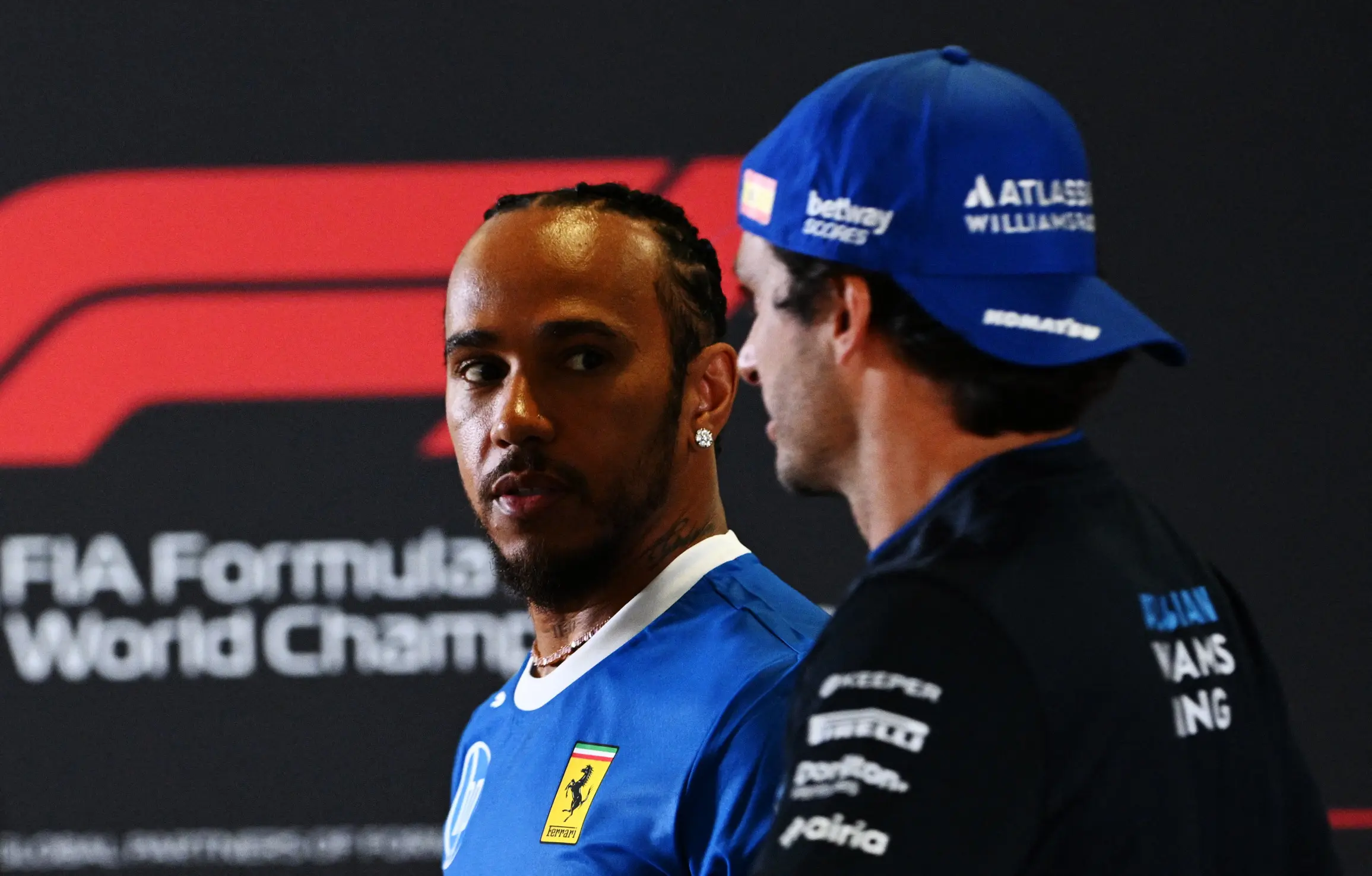
Title: Lewis Hamilton’s Ferrari Dream: A Flawed Future for F1’s Greatest?
In a world where legends are born and the roar of engines defines destinies, the question looms large: could Lewis Hamilton have replicated Michael Schumacher’s monumental success at Ferrari? The answer, however, is wrapped in a web of complexities and daunting realities that suggest the Italian team’s flawed structure may stifle even the greatest drivers.
Imagine a scenario where Hamilton, the seven-time world champion, steps into the iconic red Ferrari, flanked by a powerhouse team: Adrian Newey crafting revolutionary designs, Andrea Stella steering the ship with the precision of Ross Brawn, and Christian Horner wielding the influence of Jean Todt. This formidable quartet, armed with an unlimited budget and a corporate management that knows to stay out of their way, could have set the stage for Hamilton to not only chase Schumacher’s legacy but potentially carve out his own.
Yet, this tantalizing fantasy remains just that—a fantasy. The stark truth is that Hamilton’s entry into Ferrari, marked by the absence of a supportive elite structure, mirrors the unfortunate journeys of Fernando Alonso and Sebastian Vettel. Both stellar drivers ventured into the Maranello arena without the foundational strength to enact the transformative changes needed to restore Ferrari to its former glory.
As Hamilton contemplates a move to Ferrari, he faces two ominous hurdles: doubts about his own performance and the presence of Charles Leclerc, a rising star whose potential remains untapped due to the limitations of his machinery. Leclerc, a product of Ferrari’s own driver development program, embodies the challenge of a team that has historically faltered with ’employee drivers.’ The specter of past failures looms large—Ferrari’s golden eras were defined by fierce, dominant personalities like Schumacher and Niki Lauda, who reshaped the team around them.
The narrative threads deeper into Ferrari’s history, where strong-willed drivers like John Surtees have faced both triumphs and betrayals within the organization. Surtees himself recounted his struggles for change, ultimately leaving in protest—a cautionary tale that resonates with Hamilton’s current predicament. In the high-stakes world of Formula 1, confidence and performance are paramount; without them, even the most illustrious careers can fizzle out.
Hamilton’s plight is compounded by the fierce competition posed by Leclerc, who presents a formidable challenge unlike that of past teammates such as Eddie Irvine or Rubens Barrichello. The internal dynamics at Ferrari are notorious, with an unwillingness to accept criticism and an aversion to the collaborative culture essential for a high-performing team. History shows that when Ferrari is led by compliant employees rather than assertive champions, it loses its competitive edge.
Amidst this chaotic backdrop, Hamilton’s legacy hangs in the balance. Can he muster the authority and charisma necessary to galvanize a team that seems resistant to change? As former Ferrari principal Maurizio Arrivabene recently commented, the misalignment of roles can spell doom for any driver’s ambitions. When drivers are relegated to mere contributors rather than influential leaders, the entire organization suffers.
John Elkann’s recent remarks that Hamilton and Leclerc should focus solely on driving rather than engage in dialogue signal a troubling trend. The essential conversations needed to revolutionize Ferrari seem unlikely to happen, trapping Hamilton in a cycle of mediocrity.
As the clock relentlessly ticks, the dream of Hamilton reviving his career in a Ferrari, akin to Muhammad Ali’s storied comebacks, feels increasingly out of reach. For him to seize this opportunity, the entire Ferrari apparatus must rally behind him—a feat that appears improbable given the current mentality.
In conclusion, the path ahead for Lewis Hamilton at Ferrari is fraught with obstacles. To realize the dream of rekindling the flames of Ferrari’s glory days, a seismic shift in the team’s culture and management is essential. Without it, even the most talented driver in the world may find himself thwarted by the very team he hopes will be the stage for his greatest triumphs.


