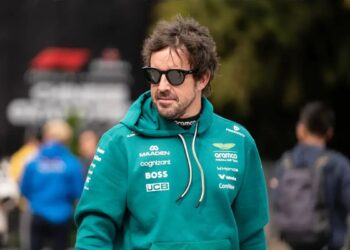
The Diminishing Thrill of Formula 1: Fernando Alonso Sounds the Alarm!
As the countdown to 2026 ticks on, Formula 1 gears up for a seismic shift that could redefine the future of the sport. Two-time world champion Fernando Alonso, a veteran of the circuit, has thrown down the gauntlet, declaring that the golden era of F1 may be irrevocably lost. His revelations raise critical questions: Is Formula 1 morphing into a management challenge rather than an adrenaline-fueled race? Are drivers being forced to relinquish the raw thrill of racing for a more calculated approach?
Alonso, who has seen it all since his debut at the 2001 Australian Grand Prix, is not shy about expressing his concern. He believes the upcoming technical regulations could signal a dramatic shift in how drivers approach their craft. “Some of the energy management and some of the driving that you have to do in order to optimize the energy around the lap, and sometimes even in qualifying, is a little bit annoying from a driver point of view,” he lamented. “You want to drive at 100%, and I think now you need to think a little bit more than that.” This shift towards efficiency over instinct could spell disaster for the essence of racing.
Alonso’s experience in other racing disciplines, such as IndyCar and World Endurance Championship (WEC), has given him a unique perspective on the changing landscape of motorsport. “I've been driving in IndyCar and the main game there is to save fuel for 75% of the race,” he explained. “At the end of the day, it's just racing.” Yet, the passion for pure, unrestrained racing seems to be fading. He reflects on the past with a sense of loss, emphasizing that the exhilarating days of the late 90s and early 2000s—when cars were light, fast, and the roar of engines filled the air—are now just a distant memory.
“I think we will never go back to the late 90s or early 2000s, where the cars were light, fast, the noise of the engine, everything was probably at the peak of the Formula 1 DNA,” Alonso stated emphatically. The V10 era, characterized by its raw power and visceral excitement, stands in stark contrast to the modern era's reliance on hybrid technology and energy management tactics. “There is for sure more adrenaline with the older cars, there is more sense of driving at the limit with the old cars,” he added.
The sentiment among fans is palpable: many yearn for the thrilling days when racing was about skill and bravery rather than complex algorithms and energy conservation strategies. Alonso himself acknowledges the need to engage a new generation of fans but is clear that the current direction of F1 lacks the visceral thrill of its predecessors. “It seems that you need to overthink a little bit while driving, and that's always a risk of having less joy behind the wheel,” he warned.
But it’s not just Formula 1 that is undergoing this transformation. The former champion draws parallels with other sports, suggesting that the trend towards structured play has permeated basketball, football, and more. “Before, 20 years ago, maybe it was a guy who had a magic night, and he won the game. Now, it’s more about structure,” he lamented. The artistry of spontaneous brilliance seems to be vanishing, replaced by a reliance on systems and strategies.
As we stand on the precipice of change, Alonso's poignant reflections serve as both a warning and a call to action for all stakeholders in the sport. Will the upcoming regulations enhance the racing experience or further dilute the raw excitement that has defined Formula 1 for decades? One thing is certain: the future of F1 is in flux, and as Alonso says, “We are moving more into a different Formula 1.” As fans and drivers alike hold their breath, only time will tell if the heart and soul of racing can survive this evolution.