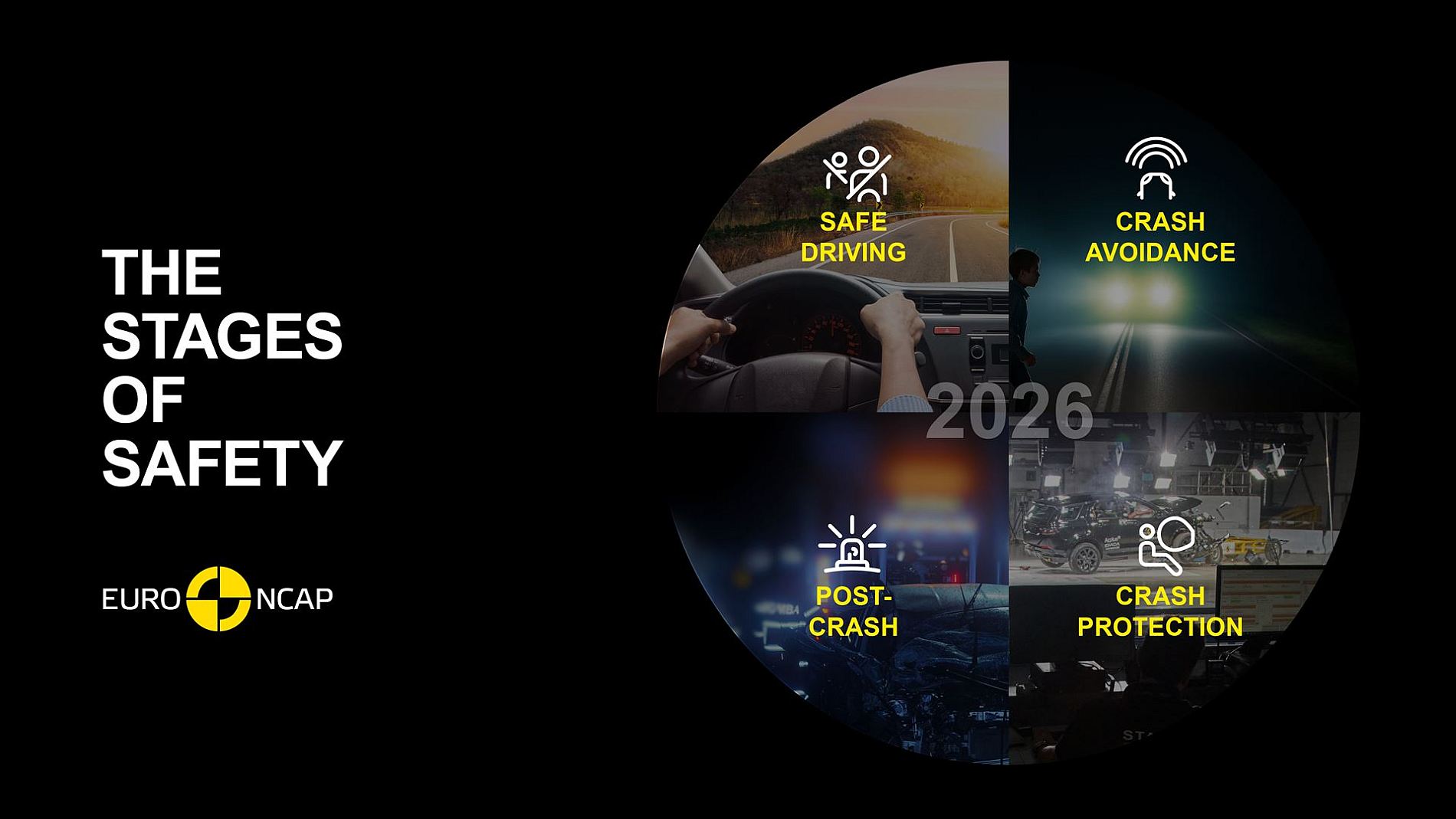
The Euro NCAP will introduce, starting in 2026, significant changes in the way it evaluates the safety of new cars, to better represent modern driving conditions and more accurately reflect the current dangers faced by drivers, passengers, and other road users. This update will constitute the most profound revision of the evaluation process since the introduction of the overall rating system in 2009, with a redesign of the testing and scoring procedures for vehicles planned, along with a new classification methodology based on four main safety pillars: safe driving, collision prevention, collision protection, and post-collision safety.
The new approach tests safety technologies in phases, allowing for the evaluation of solutions that operate in each phase, with the entity assessing the safety of new cars sold
in Europe indicating that this evolution provides “an improved framework, clarity, and flexibility, as safety technologies become increasingly complex and interconnected.” The update of the testing protocols will occur every three years.
Starting in 2026, Euro NCAP assessments will be structured around four levels of safety, each scored out of 100 points and expressed as a percentage. The minimum thresholds will continue to apply to each stage and will determine the overall star rating.
The first level is Safe Driving, which considers the technologies and features of the vehicle that contribute to a safer driving experience for all occupants, including the accuracy of driver monitoring systems and detection of signs of driving under the influence of alcohol – but also the ability to autonomously stop the vehicle if the driver does not respond to visual and auditory stimuli to control it. Human-Machine interaction and ease of access to vehicle controls (notably with physical buttons for the most common functions) will also be taken into account, particularly due to the distraction risk they may pose.
The second level, Collision Prevention, evaluates collision prevention systems that help avoid or mitigate critical incidents through warnings or autonomous intervention, such as autonomous emergency braking or lane keeping assistance.
These two levels assess what precedes potential accidents and may help to prevent them, while the next two focus on the accidents themselves. The Collision Protection level evaluates the performance of traditional protection elements in the event of a crash, such as the vehicle structure, or the functioning of seat belts, airbags, and headrests, to mitigate injuries to vehicle occupants, pedestrians, and cyclists.
Finally, the Post-Collision Safety level addresses the moments following an accident, which are always crucial, assessing the emergency response through post-collision rescue information and assistance systems. Euro NCAP will award higher scores to vehicles that provide information about the number of occupants, requiring the recognition of passengers even if they are not wearing seat belts. In the case of electric vehicles, the driver must be informed of the risk of battery fire after an accident, alerting them if it is detected immediately.
Euro NCAP will also introduce new expanded test scenarios to improve the robustness of collision prevention systems, particularly in conditions that are more representative of real-world environments. On the other hand, collision protection assessments will be expanded to include a broader spectrum of occupant body sizes, from children to shorter and taller adults, using full-scale crash tests, laboratory tests with vehicles pulled by “sleds,” and advanced virtual simulations to increase accuracy and promote more adaptable restraint systems.
Other aspects will now be included in the assessments to directly address new trends in the automotive industry. Among the new post-collision requirements are the demand that electric door handles remain functional to facilitate rescue, and the mandatory isolation of the high-voltage battery in electric vehicles, among other updates to assist rescuers.