Ayrton Senna’s Secret IndyCar Test: A Bold Move That Shook Formula 1 to Its Core!
In the winter of 1992, the racing world was blindsided by a daring maneuver orchestrated by none other than Ayrton Senna, the legendary three-time Formula 1 world champion. Despite his status as the crown jewel of McLaren and a titan in the sport, Senna was grappling with mounting frustrations over the direction of Formula 1. As Williams surged ahead, powered by Renault’s cutting-edge technology and active suspension systems, McLaren found itself lagging behind, relying on customer Ford engines following Honda’s abrupt exit.
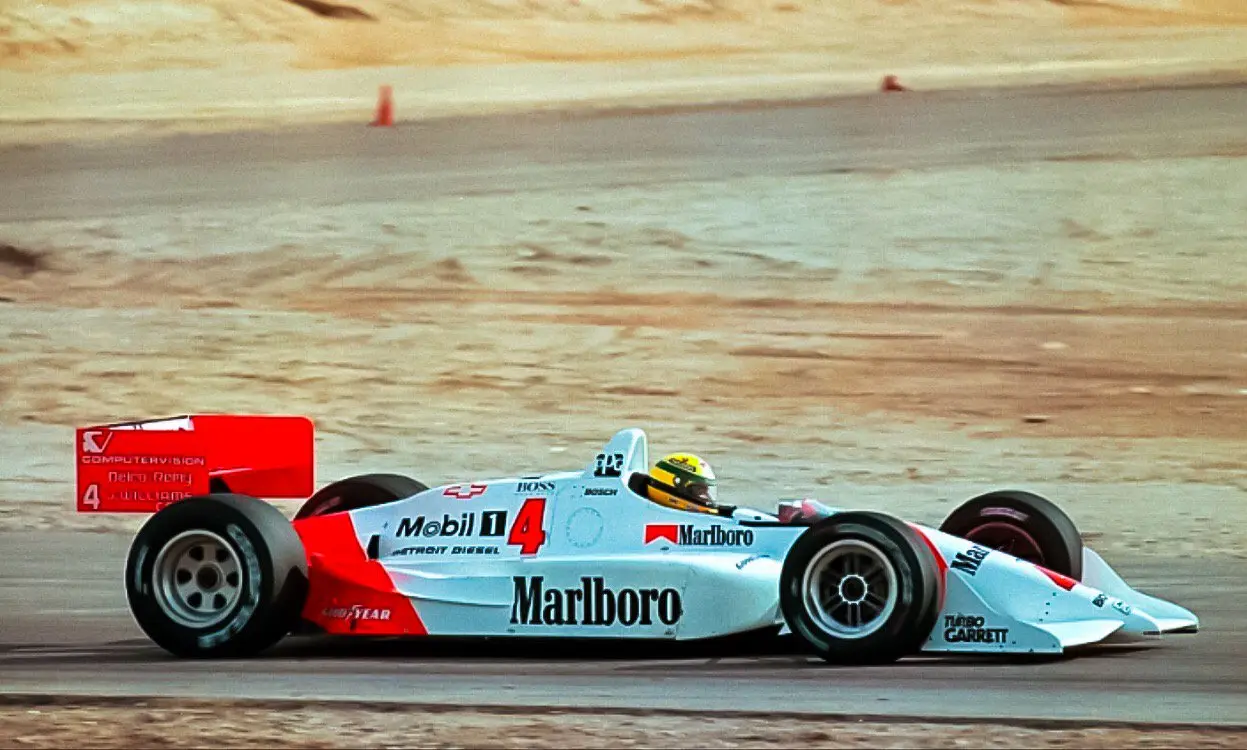
Then, in a move that sent shockwaves through the Formula 1 paddock, Senna slipped away to Firebird Raceway near Phoenix, Arizona, for a clandestine test that would change the narrative. On a seemingly ordinary December day, he traded his McLaren MP4/7A for a Chevrolet-powered Penske PC21 IndyCar, far from the prying eyes of the F1 media circus. This was no mere joyride; it was a calculated statement of intent, a question posed to the universe: Could Senna still dominate in a realm stripped of electronic aids and the relentless politics of F1?
The Penske PC21 was an entirely different beast. It was heavier, more physical, and devoid of the high-tech aids that defined F1 cars of the era. Relying solely on mechanical grip, raw bravery, and extraordinary finesse, Senna approached the test with his signature methodical precision. He meticulously studied braking points, throttle response, and how the car danced at the limit. It didn’t take long for him to leave the competition in the dust. In a mere handful of laps, he was already clocking competitive speeds, and then came the jaw-dropping moment that left the Penske team in disbelief: Senna shattered Emerson Fittipaldi’s benchmark by a staggering half a second, all while being a complete rookie in IndyCar racing.
Nigel Beresford, the head of engineering at Penske during that fateful test, recalled the moment vividly: “He came back into the pits and said: ‘Thank you very much, I’ve learned what I need to know.’ Then he got out of the car, and that was it.” Roger Penske himself later acknowledged the broader implications of Senna’s test, recognizing its potential impact not only on IndyCar but also on the F1 landscape. “If Senna was available, we’d have tried to figure something out,” he remarked, adding, “But I think he was using us as maybe somewhat of an impact against the McLaren guys at that point to try and get his deal put together.”
This assertion was astutely accurate. News of the test reached McLaren with alarming speed, signaling a stark warning to the team that their star driver had viable alternatives. Senna’s flirtation with IndyCar was not fueled by boredom with Formula 1; it stemmed from a deep-seated frustration with the technical regulations that favored manufacturer-backed teams. With McLaren’s sudden loss of works status, he found himself questioning his ability to continue competing for championships.
For a fleeting moment, the allure of American open-wheel racing beckoned. The IndyCar series was thriving, with Nigel Mansell preparing to make his own leap in 1993, and the thought of Senna’s presence promised to elevate the series to unprecedented heights. Penske’s genuine interest was palpable, and the challenge of the Indianapolis 500 loomed large on the horizon. However, Senna’s heart ultimately remained tethered to Formula 1. The Phoenix test had achieved its purpose: a bold assertion of his freedom and a power play that applied pressure on McLaren.
In response, McLaren swiftly fortified its relationship with Ford for the upcoming 1993 season, ensuring that Senna would stay put. That season would go down in history, showcasing some of the most iconic performances of his illustrious career, even as Williams continued to dominate the championship landscape. Remarkably, this clandestine test in the Arizona desert stood as Senna’s singular foray into American open-wheel racing—a tantalizing glimpse of a reality that might have been, leaving fans and historians alike to wonder what could have unfolded had he ventured down that path.
In the grand tapestry of motorsport history, Ayrton Senna’s audacious test remains a powerful testament to his unyielding spirit and relentless pursuit of excellence, forever shaking the foundations of Formula 1 while tantalizing the imagination of racing fans worldwide.