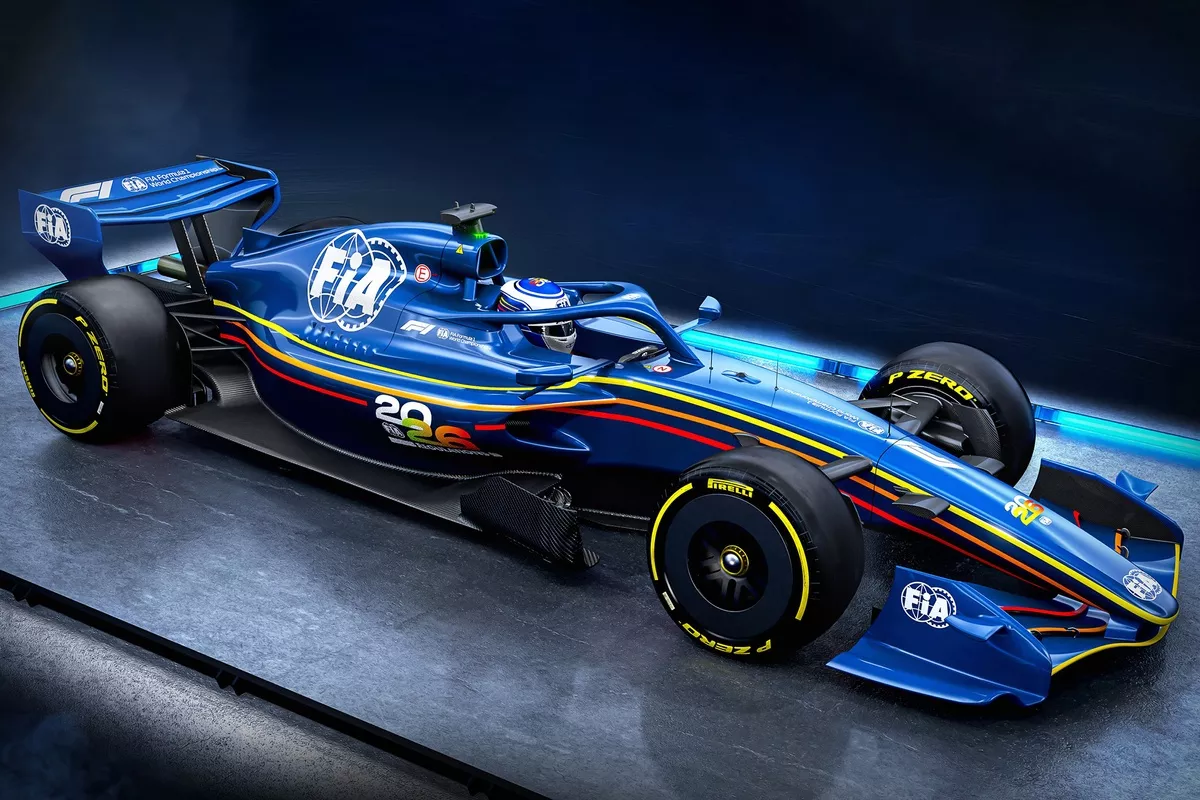
Formula 1 thrives on evolution, but 2026 isn’t just another rule change—it’s a full-scale revolution.
Christian Horner has already called it “the biggest reset in probably the last 60 years of F1”, and for once, the hype might actually be justified.
While past shake-ups like 2014’s hybrid turbo era and 2022’s ground-effect comeback were monumental, they only altered part of the equation. In 2026, for the first time in F1 history, both the chassis and the power unit regulations are undergoing a complete transformation—at the same time.
This isn’t just about making the cars faster, cleaner, or more efficient—it’s about redefining the DNA of Formula 1 itself.
Why 2026 Is F1’s Biggest Reset Yet
Unlike previous regulation overhauls that either targeted aerodynamics or engines, the 2026 rulebook disrupts both simultaneously. Legendary designer Adrian Newey summed it up perfectly:
“I can’t remember another time in Formula 1 when both the chassis regulations and the engine regulations have changed simultaneously.”
Here’s why 2026 isn’t just another rule change—it’s a full-blown reengineering of F1:
1️⃣ Power Units: The Hybrid Revolution Goes Full-Throttle
🔋 More Electric Power: The hybrid component will jump from 120kW to 250kW, shifting closer to a 50/50 split between combustion and electric power.
⛽ No More MGU-H: The highly complex MGU-H system is being eliminated, meaning teams must find new ways to maximize energy recovery.
🏎 1,000+ Horsepower Returns: Despite the hybrid shift, V6 engines will actually be more powerful, with peak output pushing past 1,000bhp.
🔄 New Fuel & Lubricants: The next-gen sustainable fuels will require massive adaptations from both engine manufacturers and oil suppliers.
🚗 Manufacturer Boom: The new rules saved F1 from an engine crisis—only Ferrari and Mercedes were expected to remain under the old system. Now, Audi, Honda, and Ford are all joining in 2026.
2️⃣ Chassis Overhaul: Smaller, Lighter, More Aerodynamically Efficient
💨 Reduced Drag: With more reliance on hybrid power, F1 needs to cut aerodynamic drag significantly—leading to sleeker, less aggressive bodywork.
📏 Downforce Cut by 15%: Cars will lose a chunk of grip, forcing teams to rethink cornering stability and setups.
🚀 Active Aerodynamics: Introduced for the first time, cars will have “straight-line mode” with adjustable bodywork to reduce drag on the straights.
🔄 Narrower Tyres: Teams will need to adapt their suspension and mechanical grip setups to account for the slimmer footprint.
⬆️ Higher Ride Heights: To discourage ultra-stiff suspensions (which caused porpoising issues in 2022), F1 is raising the minimum ride height—changing the entire ground-effect equation.
🔄 Weight Reduction Push: While F1 cars have gotten heavier every year, 2026 will attempt to reverse that trend—a crucial step for performance and tire management.
3️⃣ Active Aerodynamics: The Biggest Game-Changer
For the first time in F1 history, active aero is coming into play, bringing a level of strategy and engineering complexity never seen before.
🔘 Straight-Line Mode: Drivers will be able to adjust their car’s bodywork mid-race to reduce drag and improve overtaking.
🔘 No More DRS? While not officially confirmed, active aero could replace DRS, making battles for position even more dynamic.
🔘 Downforce on Demand: Teams will have to master the art of balancing cornering grip vs. straight-line speed, opening up entirely new strategic elements.
2026 vs. Past F1 Rule Changes – How Does It Compare?
🔄 1983 (Flat-Bottom Rule) – Ended the first ground-effect era, forcing teams to rethink car designs from scratch. Impact: Major
🔄 1994 (Electronic Ban) – Removed driver aids like traction control and ABS, forcing pure skill-based racing. Impact: Moderate
🔄 2009 (Aero Overhaul) – Simplified wings and diffusers to improve overtaking, but teams quickly found loopholes. Impact: Moderate
🔄 2014 (Hybrid Era Begins) – Introduced 1.6L turbo-hybrids, shifting F1 toward sustainability and a manufacturer-driven focus. Impact: Huge
🔄 2022 (Ground-Effect Returns) – Changed F1’s aerodynamic DNA, but kept engines untouched. Impact: Huge
🏆 2026 (Full Engine + Chassis Reset) – Combines aerodynamic and engine overhauls for the first time ever—a bigger shake-up than any previous regulation change. Impact: Biggest Ever
The Biggest Question: Will 2026 Make Racing Better?
Every rule change claims to “improve racing”, but results are often a mixed bag.
🔹 The Good
✅ More energy efficiency without sacrificing power
✅ Cars designed for better racing and closer battles
✅ Less reliance on dirty air & DRS-assisted overtakes
✅ Brings in new manufacturers and investment
🔸 The Risks
❌ Could create huge performance gaps as teams struggle to master both new aerodynamics and hybrid tech
❌ More complexity could increase costs, hurting smaller teams
❌ Manufacturers might struggle to balance electric vs. combustion power delivery, leading to boring, conservative racing
F1 must strike a delicate balance—but one thing is certain:
2026 will redefine what Formula 1 looks like for the next decade.
Final Verdict: The Biggest F1 Revolution Ever? Yes.
While previous rule changes have transformed F1, none have overhauled both aerodynamics and power units at the same time.
🔹 2026 is a bigger reset than 2014 – because while hybrids changed F1, the chassis rules remained largely intact.
🔹 2026 is bigger than 2022 – because even though ground-effect cars returned, the power units stayed the same.
🔹 2026 is bigger than 1983 – because while flat-bottom regulations killed ground effect, engines were untouched.
For the first time in modern F1 history, teams will have to rethink every single aspect of car design at once—making 2026 truly the biggest rule change in the sport’s history.
🚀 Will it bring better racing? Time will tell.
🔥 Will it change F1 forever? Absolutely.
Buckle up—Formula 1’s biggest reset is coming.