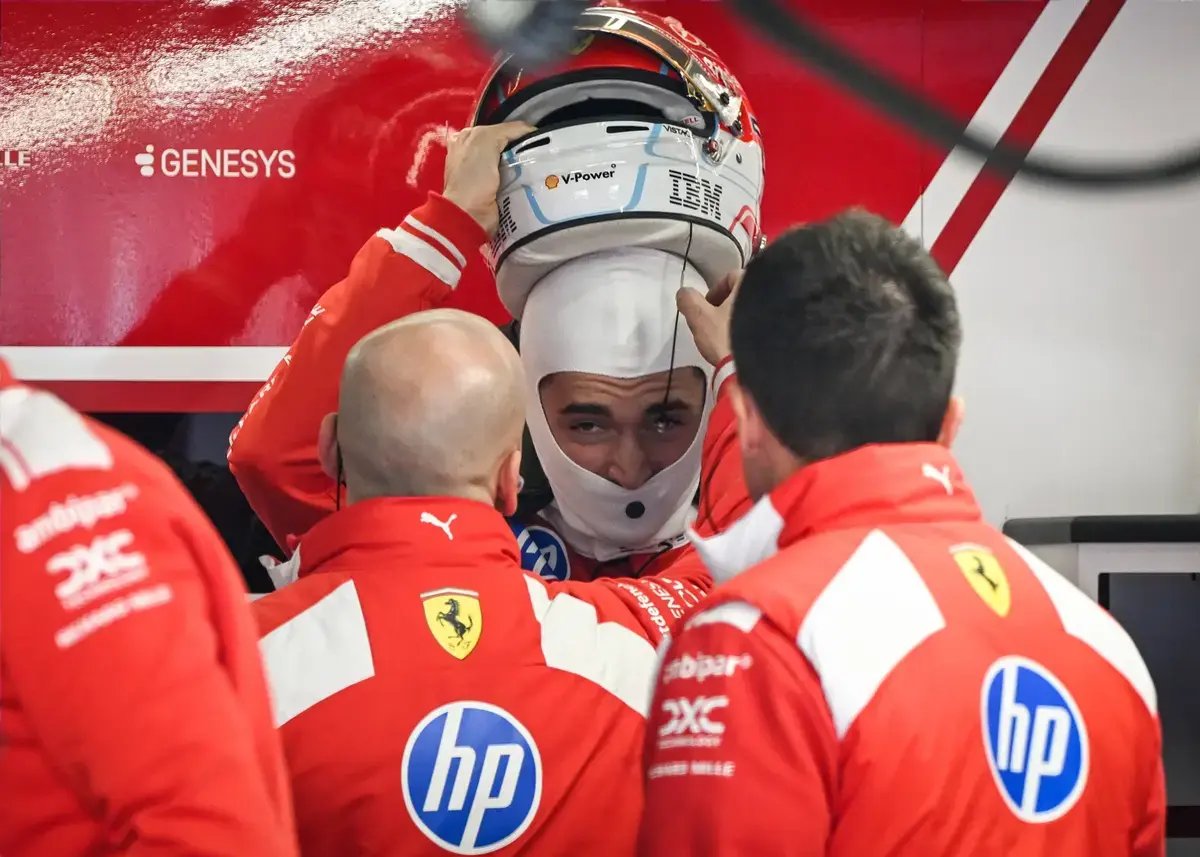
Title: Charles Leclerc's Sprint Qualifying Drama: A Deep Dive into the Intricacies of Modern F1 Power Units
In the high-octane world of Formula 1, every millisecond counts, but the complexities of the latest power units can turn even the most promising laps into missed opportunities. Charles Leclerc's recent experience during the sprint qualifying for the Chinese Grand Prix serves as a stark reminder of this reality. With the stakes at an all-time high, Leclerc found himself in a nail-biting situation that left fans and experts alike questioning the intricate dance of technology and strategy that defines the sport today.
As the engines roared to life on that fateful day, Leclerc's initial laps in SQ3 hinted at a potential fight for pole position. However, as he sped down the long 1.2-kilometer back straight, a sudden loss of energy transformed his hopes into despair. What seemed like a solid lap turned into a heartbreaking missed opportunity, as Leclerc's power unit cut out earlier than his competitors, costing him precious tenths of a second and relegating him to a disappointing position.
This incident raises a crucial question: why does Leclerc's predicament illuminate the baffling complexities of modern power units? The answer lies in the delicate balancing act that teams must perform, navigating a myriad of variables that can shift the dynamics of a race weekend in the blink of an eye. The 2023 technical regulations have ushered in a new era of power units that are not only more potent but also far more intricate. The experience gained over time is invaluable, yet even seasoned drivers can find themselves grappling with unforeseen challenges.
Just a week prior during Australian GP qualifying, Leclerc had faced similar issues, where hybrid management misconfigurations hindered his performance. In that instance, he was fortunate enough to return to the pits and reset the parameters. Unfortunately, SQ3 provided no such luxury; it was a final attempt fraught with uncertainty and a lack of recalibration options.
The current power units are akin to a double-edged sword, operating under complex systems that adapt energy management based on variables such as grip conditions and tire wear. This year's regulations have amplified the importance of energy management, transforming what was once a minor factor into a game-changer, especially during qualifying sessions where every detail is pushed to its limits.
Leclerc's situation starkly illustrates the critical role of energy strategy. With the MGU-H's support stripped away and the MGU-K's power output effectively tripled, understanding when and how to deploy energy has become a vital skill. An erroneous strategy can lead to disastrous lap times, as Leclerc discovered in SQ3.
Analyzing Leclerc's two attempts in Q3 reveals subtle yet significant differences that carry substantial implications for performance. In his first attempt, he navigated Turn 8 and the subsequent acceleration zone in a manner that starkly contrasted with his second lap. He shifted gears differently, opting for fourth in the first attempt and fifth in the second, resulting in a marked difference in engine revs and cornering speeds—about 15 kph higher on the second attempt.
Moreover, energy management took center stage during his acceleration towards Turn 11. In his first lap, the power unit prematurely cut energy, entering a “super clipping” phase too early and missing out on crucial recharge opportunities. In contrast, the second lap saw Leclerc shift up to seventh gear, allowing him to reach peak speeds that were 9 kph higher, thereby maximizing energy deployment on the long straight.
Among the frontrunners, Leclerc's laps exhibited the most pronounced variations in energy management strategies, while his competitors maintained a steady approach. It’s no wonder he expressed frustration over the radio post-lap, with his engineer clarifying that a significant chunk of the lost time stemmed from his handling of Turn 8.
It’s evident that the systems within these power units learn and adapt in real-time. With the compressed schedule of a sprint weekend offering no chance for recalibration, Leclerc's SQ3 experience was an intricate puzzle of energy management that ultimately proved too complex to solve under pressure.
The juxtaposition between Leclerc's lap and Lewis Hamilton's highlights the stakes involved. Hamilton's early downshift and strategic throttle application allowed him to conserve energy, showcasing the critical importance of precision and foresight in this advanced era of racing.
In conclusion, Charles Leclerc’s thrilling yet frustrating sprint qualifying at the Chinese Grand Prix underscores the multifaceted challenges that drivers face in today’s Formula 1 landscape. As teams continue to grapple with the evolving technology of power units, one thing remains clear: understanding energy management will be the key to unlocking victory in a sport where every fraction of a second can make all the difference.