While the motorcycle favorites were deliberately held back until the very end of the Dakar Rally prologue, the car category wasted no time turning the stopwatch ruthless.
Moments after Daniel Sanders closed the motorcycle running on the 22-kilometer special stage, the spotlight shifted to the four wheels — with Lucas Moraes leading the cars onto the same course.
The running order was clear and unforgiving: Ultimates first, followed by Stock, Challengers, SSVs, and finally the trucks. Unlike the motorcycles, however, the prologue times for cars do not count toward the overall standings — a crucial detail that would later soften some heavy blows.
Moraes Sets the First Marker — And It Doesn’t Last
As the first car on the road, Moraes — sharing the Dacia Sandrider with navigator Dennis Zenz — stopped the clock at 11:22.2. It was a respectable opening benchmark, but one that quickly proved insufficient even for the top ten.
His teammate Nasser Al-Attiyah immediately dipped under the 11-minute barrier with a 10:56.6, though even that was not enough for a podium spot. The five-time Dakar winner ultimately settled for fourth, less than eight seconds off the top.
Ekström Strikes First as Ford Flexes Its Muscle
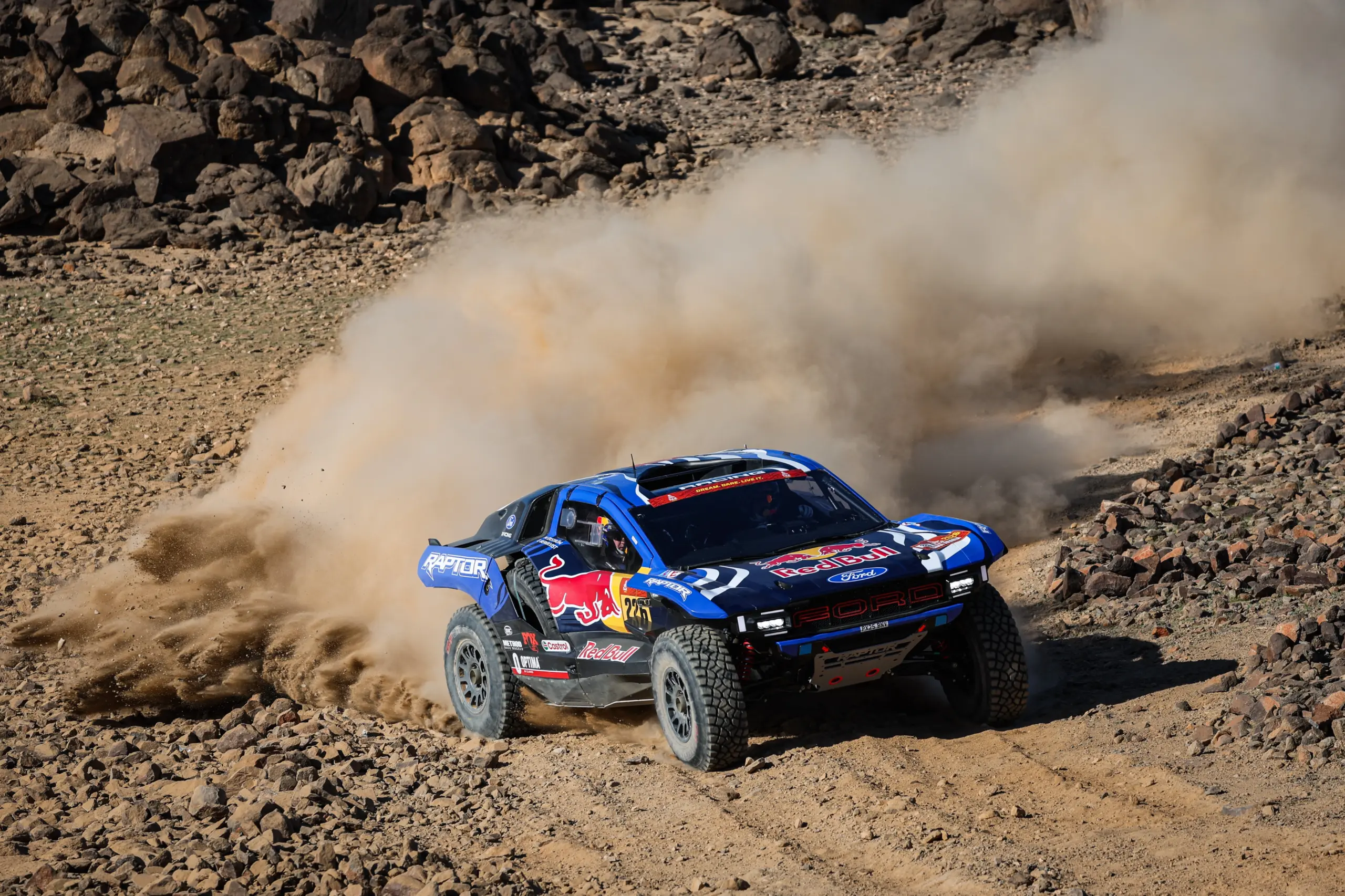
The fastest time of the prologue belonged to Mattias Ekström.
Driving the Ford Raptor alongside co-driver Emil Bergkvist, Ekström delivered a razor-sharp lap of 10:48.7, setting the standard for the entire car field.
Ford’s strength was immediately underlined when teammate Mitch Guthrie, with Kellon Walch, went more than seven seconds faster — but still had to settle for second, as the margins behind him were microscopic.
Four Crews Under Eleven Minutes — Nothing Between Them
The fight at the front was brutally tight:
- Second place: Guthrie / Walch
- Third place: Guillaume de Mévius / Mathieu Baumel in the X-Raid Mini, just two tenths behind
- Fourth place: Al-Attiyah / Fabian Lurquin, only three tenths further back
These four were the only crews to break the 11-minute barrier, instantly marking themselves as the early Ultimate class reference.
Toyota Leads the Chase as the Field Compresses
Behind the front quartet, the stopwatch showed no mercy. Just 1.5 seconds separated fifth through ninth:
- Fifth: Seth Quintero / Andrew Short, Toyota’s strongest pairing
- Sixth: Defending champions Yazeed Al-Rajhi / Timo Gottschalk
- Seventh: Ultimate debutant Eryk Goczal / Szymon Gospodarczyk
- Eighth: Carlos Sainz / Lucas Cruz, third Ford Raptor
- Ninth: Mathieu Serradori / Loïc Minaudier, fastest Century pairing
The top ten was completed by Saood Variawa / François Cazalet in the Toyota Gazoo Racing SA Hilux.
Lategan Escapes Disaster Thanks to Prologue Rules
One major name missing from the top ten was Henk Lategan, runner-up at Dakar last year.
Together with Brett Cummings, Lategan was competitive early — fifth fastest after ten kilometers — but hemorrhaged nearly two minutes to Ekström in the second half of the stage.
Crucially, the prologue does not count toward the overall classification, sparing the Toyota factory driver from early damage.
Even so, he finished behind the best Dutchman of the day, Janus van Kasteren, the 2023 truck winner. Van Kasteren and Marcel Snijders secured a respectable 22nd place in their Shiver Offroad Century.
A Warning Shot, Not a Verdict
The prologue may not count for the cars — but the message was unmistakable.
Margins are microscopic.
Ford is fast.
Toyota is close.
And the Dakar Rally has already begun squeezing mistakes out of the field.
The stopwatch has spoken.
The real damage starts now.