
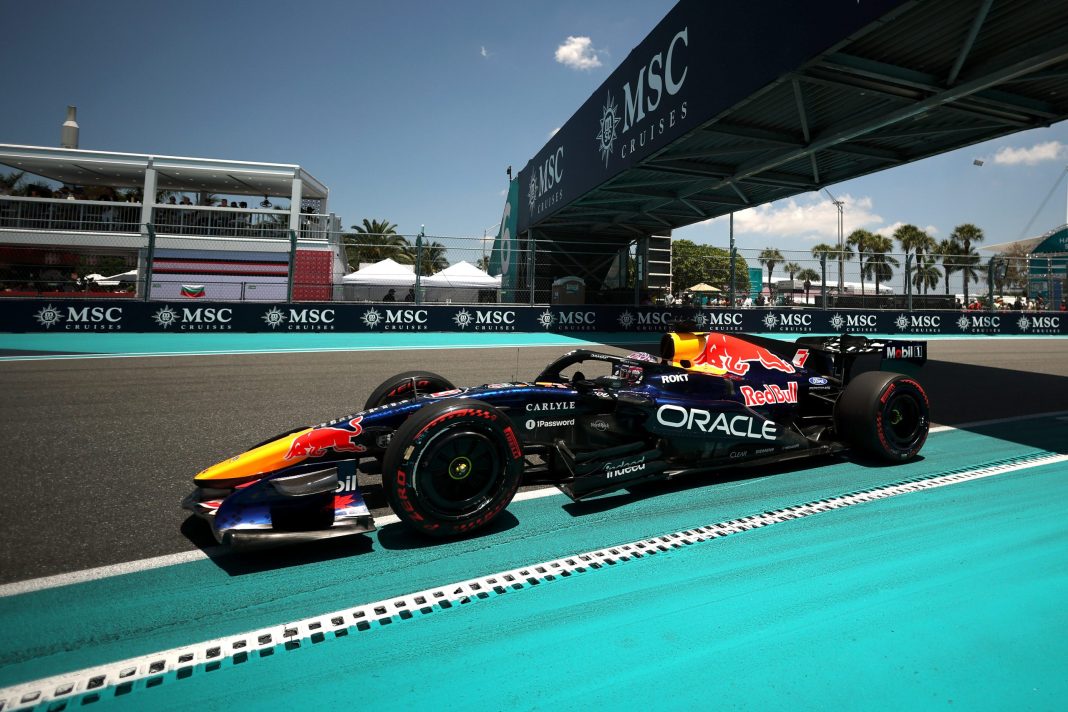

Title: Formula 1 Shake-Up: Red Bull Surges Ahead While Ferrari’s Ambitious Upgrades Fall Flat in Miami!
In a stunning revelation following a five-week hiatus, the Formula 1 landscape has undergone a seismic shift! The Miami Grand Prix has not only crowned Kimi Antonelli as the victor yet again, but it has also unveiled a new hierarchy among the teams, igniting fierce competition and raising eyebrows among fans and analysts alike.
Initially, the 2026 season saw Mercedes dominating the track, boasting an impressive qualifying lead of 0.56 seconds over its closest rival and an astonishing race pace advantage of 0.53 seconds per lap. However, the tides have turned dramatically in Miami, with the Silver Arrows' supremacy visibly eroding under the pressure of relentless competition.
In a jaw-dropping performance, Antonelli’s qualifying lap translated into a mere 0.35 seconds advantage, while Mercedes barely edged out McLaren by a scant 0.02 seconds per lap during the race. This stark reduction in performance showcases a staggering loss of two tenths in qualifying and over half a second in race pace compared to the season's commencement.
So, what’s behind Mercedes’ decline? The answer isn’t just updates—or the lack thereof. While rival teams unleashed a barrage of upgrades, Mercedes opted for a more cautious approach, bringing only two minor tweaks: a rear-end optimization designed to lessen drag and minor adjustments to front brake cooling. In stark contrast, Ferrari unleashed a staggering eleven new components, while both Red Bull and McLaren brought seven each—clearly reaping the benefits.
But the drama doesn’t end there. Miami has historically posed challenges for Mercedes, with the team previously struggling to find its footing on this track. Historical data reveals that Mercedes typically lags by 0.22 seconds per lap in Miami compared to its typical performance—a staggering factor contributing to their recent struggles.
Interestingly, regulatory changes have not been viewed as a decisive factor in the recent shake-up, with McLaren’s team principal Andrea Stella asserting that their improvements stem from better teamwork rather than rule adjustments.
As teams scramble to close the gap, Red Bull emerges as a formidable contender, showcasing an eye-popping leap of 0.92 seconds per lap improvement compared to the season’s initial races. Even after factoring in track characteristics, Red Bull’s advancement is still an impressive 0.7 seconds—an extraordinary feat that signals their intent to reclaim dominance.
McLaren isn’t far behind, trimming the deficit to Mercedes by 0.80 seconds, with adjusted figures suggesting a real gain of approximately 0.56 seconds. Despite previous trends indicating their resurgence in Japan, this Miami performance cements their status as fierce challengers.
Now, let’s turn our attention to Ferrari, which, despite introducing the largest upgrade package, faced an underwhelming outcome. Their race pace deficit improved slightly to 0.46 seconds per lap, yet when considering Miami’s favorable conditions for the Scuderia, the adjusted figures suggest a disconcerting decline of 0.18 seconds per lap. The question looms: have they truly unlocked their potential, or are they merely treading water in a rapidly evolving race?
In the midfield, Williams has made a notable surge, clocking a significant 0.8 seconds per lap gain, although adjustments reveal this may only translate to a 0.23 seconds benefit. Alpine, on the other hand, saw their six new parts yield a disheartening regression of 0.02 seconds—a clear indicator of the fierce and unforgiving nature of this development race.
Meanwhile, Haas and Audi’s minimal updates have resulted in steep declines—Haas losing a staggering 0.45 seconds per lap, while Audi suffered a catastrophic 0.91-second drop once track effects were accounted for. In a surprising twist, Aston Martin has defied expectations, showcasing an improvement of 0.44 seconds, despite not introducing any updates.
The biggest shocker? Racing Bulls, despite their six updates, faced the largest regression of the weekend, losing a shocking 0.86 seconds per lap. Cadillac, with their nine new parts, barely scraped by with a paltry gain of just 0.02 seconds.
As the development race intensifies, one thing is clear: the stakes are higher than ever. With the Canadian Grand Prix looming on the horizon, the next chapter of this gripping saga promises more action and potential upheaval in the competitive order. Buckle up, fans—the drama of Formula 1 is just getting started!