
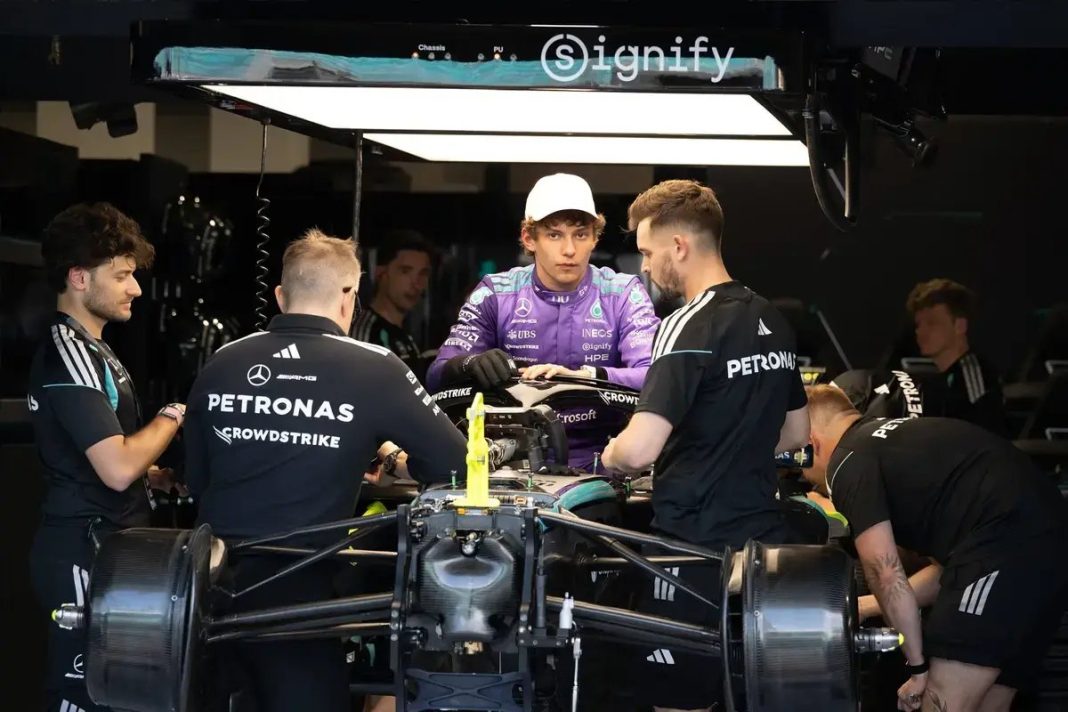

F1 Drivers Brace for Wet and Wild Miami GP: A Storm of Uncertainty Looms
As the highly anticipated Miami Grand Prix approaches, the atmosphere is charged not just with excitement but with trepidation. The looming threat of storms raises critical questions about the race conditions, particularly the possibility of rain on race day. The stakes are higher than ever, as drivers face the daunting task of navigating the unpredictable quirks and challenges posed by the 2026 cars in wet conditions for the first time.
The current generation of F1 cars is already notorious for their peaky torque characteristics, which make handling a challenge even in dry conditions. Add rain into the mix, and the complexity amplifies dramatically. Alpine’s Pierre Gasly, who recently endured a grueling wet shakedown at Silverstone, described the experience as “the most extreme I’ve ever done in my life,” citing wheelspin in sixth gear and the necessity for an underwear change every lap. He boldly stated, “I know I’m pretty good in these conditions, so personally I wouldn’t mind it,” but acknowledged the potential for chaos on the track, particularly in terms of grip and aquaplaning.
World championship leader Kimi Antonelli echoed the uncertainty, admitting, “Definitely it’s going to be very interesting because there’s so much unknown in the wet at the moment.” With no comprehensive competitive experience with the new cars in rain-soaked conditions, the drivers are left to grapple with the unknowns, especially regarding the performance of intermediate tires under the new regulations.
In a timely move, the FIA has implemented crucial changes aimed at enhancing safety during wet conditions. These adjustments include limiting the maximum deployment of the MGU-K to 250kW, banning boost mode, and introducing clearer rear warning light systems. Additionally, the intermediate tire blanket temperatures have been raised by a significant 10°C, aligning them with the temperatures of slicks. Yet, despite these measures, drivers remain acutely aware of the inherent risks, particularly on a flat track like Miami, where water tends to pool dangerously close to the walls.
Carlos Sainz voiced his concerns, stating, “I think at the back of everyone’s heads is, what’s going to happen when it’s wet?” He argued that the powerful 350kW deployment might not be necessary and called for a potential reduction to 250 or 300kW for the race. The flat layout of the Miami circuit, combined with the possibility of standing water, adds another layer of anxiety to an already tense situation.
Lance Stroll from Aston Martin, known for his prowess in challenging conditions, pointed out that the performance in wet weather will largely depend on the drivability of the power units. “Some cars will find it much easier than others,” he noted, highlighting how those with better downforce and grip will thrive, while others could struggle significantly.
However, some teams are better prepared for the potential deluge. Ferrari and Red Bull took advantage of wet-weather conditions during their pre-season testing, while Lewis Hamilton has logged extensive wet laps at both Barcelona and Fiorano. Hamilton remarked, “I’ve definitely done more wet testing than probably ever before,” underscoring the importance of preparation in the face of uncertainty.
Yet, amidst the looming storm clouds, George Russell struck a defiant tone: “This is F1. At the end of the day, we are racing Formula 1 and not Formula 4. It has to be the fastest cars in the world.” As the drivers gear up for what could be a historic and challenging race, one thing is clear: the Miami Grand Prix promises to deliver high-octane drama, thrilling maneuvers, and perhaps a few nail-biting moments as they navigate the wet track. Buckle up, fans—this race could be one for the ages!