
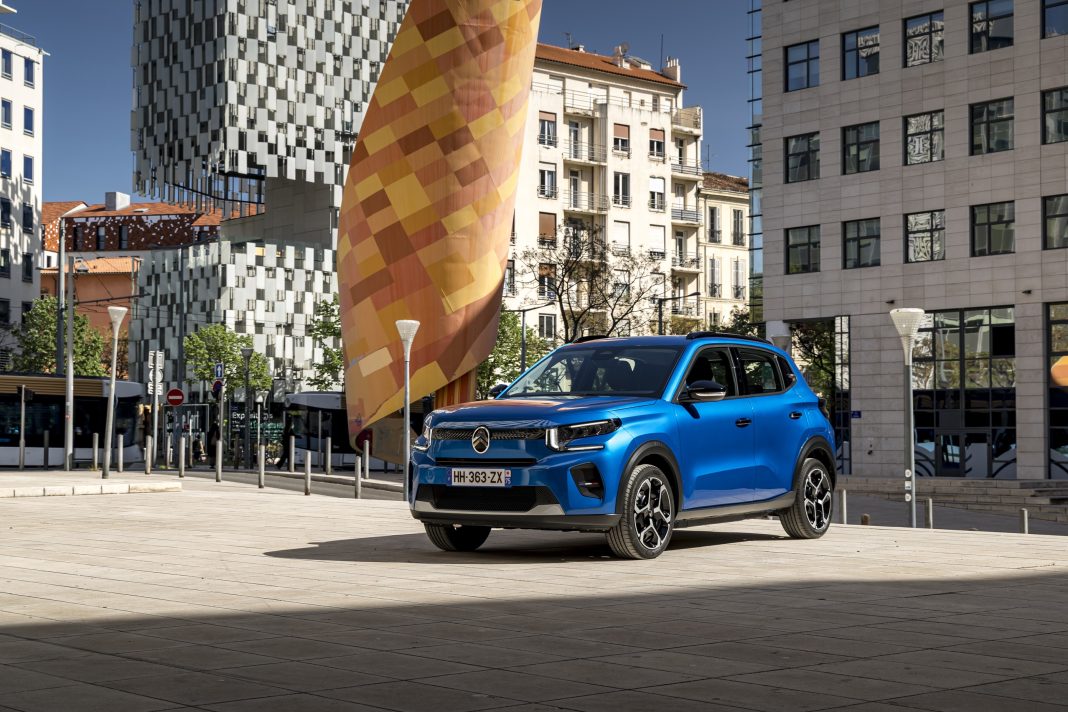

Citroën has just clearly reinforced its offensive in the market for affordable electric vehicles with the launch in Portugal of the new ë-C3 Urban Range, a version that aims to bring electric mobility closer to the general public and consolidate the brand’s position in one of the most important segments of the national market.
In a context where price remains one of the biggest barriers to the adoption of 100% electric cars, the French brand’s proposal comes with compelling arguments that are hard to ignore. With a recommended price starting at 19,990 euros, and an ongoing commercial campaign that lowers the entry price to 17,990 euros, the new ë-C3 Urban Range positions itself as one of the most competitive offerings in the electric B segment in Portugal.
And Citroën does not arrive at this moment by chance. The model was already the best-selling electric hatchback in the B segment in the Portuguese market in the first quarter of 2026, a fact that reinforces the strategic importance of the ë-C3 in the brand’s new phase.
An electric vehicle designed to democratize mobility
The arrival of this new urban range version is not just another extension of the lineup. It is a central piece in Citroën’s strategy to broaden access to electric mobility to a wider audience, especially among urban drivers and users looking for a practical, economical, and easy-to-use car in their daily lives.
Present on the Citroën Smart Car platform, common to the electric, hybrid, and gasoline versions of the range, the ë-C3 Urban Range was designed to meet the most realistic daily needs, without inflating the product with excessive specifications that would ultimately push the price to less accessible levels.
This is precisely where the model seems to find its purpose: to offer a rational, honest, and competitive electric solution, without losing the comfort, equipment, and safety features that are now demanded even in entry-level segments.
Powertrain tailored for urban use, without exaggeration
In technical terms, the new ë-C3 Urban Range features an 83 kW electric motor, equivalent to 113 horsepower, paired with a 30 kWh LFP battery.
This configuration allows for a maximum WLTP range of 212 kilometers, a figure that, while not ambitious for long distances, seems perfectly aligned with the car’s mission. We are not looking at an electric vehicle designed for constant highway travel or long intercity commutes. We are looking at a car clearly oriented for urban and suburban use, where daily journeys are shorter and more predictable.
The choice of an LFP battery also reinforces this logic. It is a chemistry increasingly valued for its robustness, durability, and more controlled cost, helping to keep the final price of the car at more competitive levels.
Simple charging adapted to the user’s reality
In terms of charging, the ë-C3 Urban Autonomy comes equipped with a single-phase onboard charger of 7.4 kW and also supports DC fast charging up to 30 kW.
These are not particularly impressive numbers on paper, but they reflect a pragmatic approach. For a typical user of this model, who will charge it at home, at work, or at public charging stations during longer stops, this solution seems sufficient and consistent with the car’s positioning.
Citroën did not want to turn the ë-C3 into a technological showcase. It aimed to make it a credible tool for those who want to enter the world of electric vehicles without paying too much for it.
Strong equipment from the base version
One of the most interesting aspects of this new proposal is the level of equipment right from the entry-level version You. Citroën clearly sought to avoid the feeling of a “too cheap model,” opting for a fairly complete endowment for the segment.
Among the main standard features are:
- Citroën Head-Up Display
- My Citroën Play system with smartphone station
- air conditioning
- light sensor
- electric mirrors
- Citroën Advanced Comfort suspension
- cruise control with speed limiter
- hill start assist
- traffic sign recognition
- active safety braking
- front collision warning
- lane departure alert
- driver attention alert
- six airbags
- ESP and ABS with electronic brake distribution
In other words, even the entry-level version comes with strong arguments in comfort and safety, something particularly important at a time when many customers are looking for affordable electric vehicles without wanting to give up a minimum level of modernity.
Plus version elevates comfort and technology
For those who want something more, the Plus version adds a set of elements that make the ë-C3 more appealing and more complete, without straying too far from the accessibility level.
This variant includes:
- roof bars
- 10-inch touchscreen
- wireless projection
- Citroën Advanced Comfort seats
- height-adjustable driver’s seat
- heated mirrors
- rain sensor
- automatic switching between medium and maximum
With this configuration, the model gains a more robust presentation and a more up-to-date technological experience, coming closer to offerings from higher segments, especially for those who value connectivity and comfort in daily use.
There is also a VAN version for professionals
Citroën has also decided to expand the offering with a brand new VAN version, certified as N1, designed for professionals, namely urban delivery operators and small businesses.
In a market where last-mile logistics is growing rapidly and environmental restrictions in cities are likely to increase, this variant could play a significant role, offering a practical, efficient electric solution aligned with the new demands of professional mobility.
Prices: here is the real trump card
But it is in the pricing chapter that the ë-C3 Urban Range truly attempts to make a difference.
With the current campaign in effect for private customers, the prices are as follows:
- ë-C3 Electric 113 hp Urban Range YOU – 17,990 euros
- ë-C3 Electric 113 hp Urban Range PLUS – 19,700 euros
Without a campaign, the recommended prices are:
- ë-C3 Electric 113 hp Urban Range YOU – 19,990 euros
- ë-C3 Electric 113 hp Urban Range PLUS – 23,300 euros
- ë-C3 Electric 113 hp Urban Range VAN – 23,450 euros
In a market where many electric vehicles continue to emerge with prices significantly above the psychological threshold of 20,000 euros, Citroën is clearly seeking to occupy a strategic space: that of affordable, concrete, and mass electrification.
Warranty reinforces confidence in the proposal
Another important point is the after-sales coverage. The ë-C3 Urban Range benefits from the “Citroën We Care” warranty, which covers the main components related to the powertrain for up to eight years or 160,000 km. The battery also benefits from an eight-year or 160,000 km warranty.
In a product aimed at customers potentially more sensitive to durability and total cost of ownership, this type of coverage is a relevant and reassuring argument.
A key car for the new Citroën
The new ë-C3 Urban Range does not aim to impress with exuberant numbers, excessive luxury, or radical performance. Its goal is different, and perhaps more important: to be useful, accessible, and credible.
It is precisely this strategic simplicity that could make it one of the most relevant proposals in the Portuguese market in 2026. Because, more than promising a technological revolution, this Citroën tries to solve a concrete problem: how to make the electric car truly attainable for more people.
If the brand can maintain this commercial aggressiveness and ensure real product availability, the ë-C3 Urban Range has everything to continue being one of the references in the electric B segment in Portugal.